Supreme Court Mandates Comprehensive Reforms in Higher Education Institutions to Curb Student Suicides Apex Court Issues Directions for Enhanced Mental Health Support, Institutional Accountability, and Inclusivity in HEIs
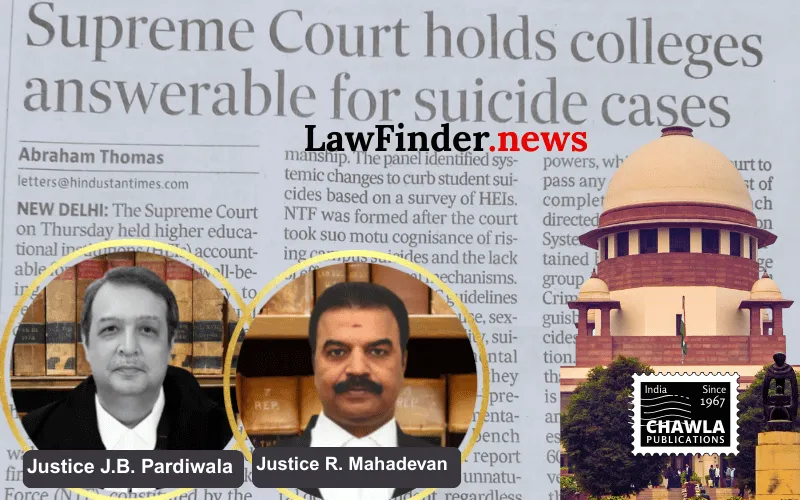
In a landmark judgment aimed at addressing the growing concern of student suicides in Higher Educational Institutions (HEIs), the Supreme Court of India has issued a series of comprehensive directives to bolster mental health support systems, ensure institutional accountability, and promote inclusivity. The judgment, delivered by Justices J.B. Pardiwala and R. Mahadevan, highlights the alarming rise in student suicides and mandates immediate reforms to mitigate this crisis.
The court, acknowledging the moral and legal obligation of educational institutions, has made it mandatory for HEIs to report all incidents of student suicides or unnatural deaths to police authorities and regulatory bodies such as the University Grants Commission (UGC) and the All India Council for Technical Education (AICTE). This step aims to ensure transparency and accountability in handling such tragic incidents.
Central to the court's directives is the constitution of a National Task Force (NTF), which has been tasked with identifying the predominant causes of student suicides and recommending preventive, remedial, and reformative measures. The interim report submitted by the NTF points to academic pressures, financial stress, and a lack of inclusivity as significant contributors to student distress. The report also highlights gaps in mental health services and calls for the establishment of a centralized data system to track student suicides.
In a move to strengthen institutional accountability, the Supreme Court has directed HEIs to comply with regulations like UGC's Promotion of Equity, Anti-Ragging Committees, and Sexual Harassment Committees. The court has also emphasized the urgency of filling vacant teaching and administrative positions, particularly those reserved for marginalized communities, within four months.
The judgment further calls for the disbursement of scholarships without penalizing students for administrative delays and stresses the importance of faculty sensitization and training to recognize and address academic, financial, and social stressors affecting students.
The court's directives extend to the creation of model Standard Operating Procedures (SOPs) for mental health services and well-being audits in HEIs, urging the Union of India and State Governments to ensure compliance and accountability in implementing these measures.
This judgment is a significant step towards creating a safer and more supportive environment for students in HEIs and highlights the Supreme Court's commitment to addressing the root causes of student suicides through systemic reforms.
Bottom Line:
The Supreme Court of India addresses the alarming rise in student suicides in Higher Educational Institutions (HEIs) and issues comprehensive directions to enhance mental health support systems, institutional accountability, and inclusivity within HEIs.
Statutory provision(s): Article 142 of the Constitution of India, UGC (Promotion of Equity in Higher Educational Institutions) Regulations, 2012, UGC (Prevention, Prohibition and Redressal of Sexual Harassment of Women Employees and Students in Higher Educational Institutions) Regulations, 2016, UGC Regulation on Curbing the Menace of Ragging in Higher Educational Institutions, 2009, UGC (Redressal of Grievances of Students) Regulations, 2023
Amit Kumar v. Union of India, (SC) : Law Finder Doc Id # 2838759