Court Emphasizes Family Court's Role in Enforcing Maintenance Payments, Not Habeas Corpus Petitions
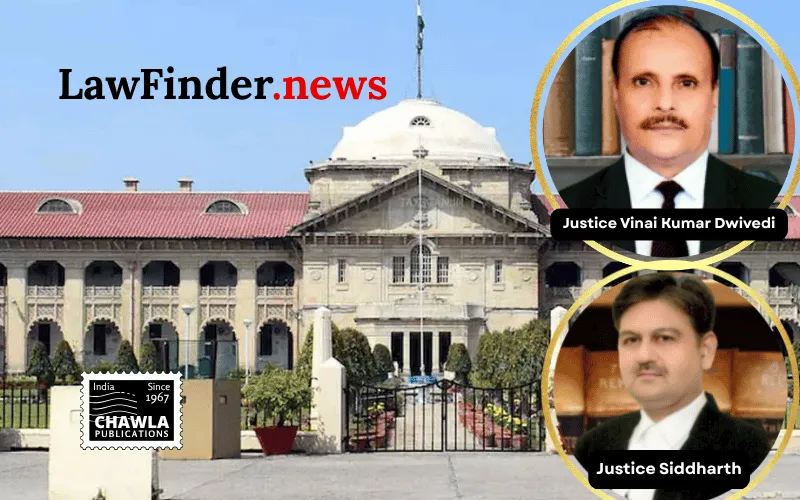
In a significant ruling, the Allahabad High Court dismissed a habeas corpus petition filed by Smt. Sangita Yadav, an estranged wife seeking the court's intervention to produce her husband, Shiv Prasad Yadav, who has evaded arrest warrants in execution proceedings for maintenance recovery. The Division Bench, comprising Justices Siddharth and Vinai Kumar Dwivedi, underscored that a habeas corpus petition is not an appropriate remedy in such cases, emphasizing the role of the Family Court in enforcing maintenance orders through coercive measures.
The petitioner, Smt. Sangita Yadav, had sought the issuance of a writ directing the respondents, particularly the police, to locate, arrest, and produce her husband before the Family Court in Azamgarh, where he was due to appear in a case concerning the recovery of maintenance arrears totaling Rs. 3,44,000. Furthermore, she requested disciplinary action against police officials for failing to execute the warrants and sought compensation for the alleged violation of her fundamental rights.
The court, however, held that the mere evasion of warrants by Shiv Prasad Yadav did not warrant a habeas corpus petition, as his whereabouts were unknown, and there was no indication of illegal detention. Instead, the court pointed to the Family Court's responsibility to employ coercive measures to ensure compliance with maintenance orders.
During the proceedings, the petitioner's counsel referenced a previous judgment by the Madras High Court in a similar matter, arguing for similar relief. However, the Allahabad High Court distinguished the present case from the Madras High Court case, where the individual in question was found to be in illegal custody, a scenario not applicable in this instance.
The judgment serves as a reminder of the procedural boundaries of habeas corpus petitions, clarifying that they are not a substitute for other legal mechanisms available to Family Courts for enforcing maintenance payments. The court's decision reiterates the importance of utilizing appropriate legal avenues for relief and enforcement in family law disputes.
With this ruling, the Allahabad High Court has reinforced the procedural frameworks that govern maintenance recovery, directing parties to pursue remedies within the jurisdiction of Family Courts.
Bottom Line:
Habeas Corpus petition cannot be used as a tool to secure the presence of an individual in execution proceedings for maintenance recovery. It is the responsibility of the Family Court to initiate appropriate coercive measures to secure compliance.
Statutory provision(s): Article 226 of the Constitution of India, Family Law (Maintenance Recovery)
Smt. Sangita Yadav v. State of Uttar Pradesh, (Allahabad)(DB) : Law Finder Doc id # 2878683