Legitimacy and Property Rights Affirmed in Complex Family Dispute
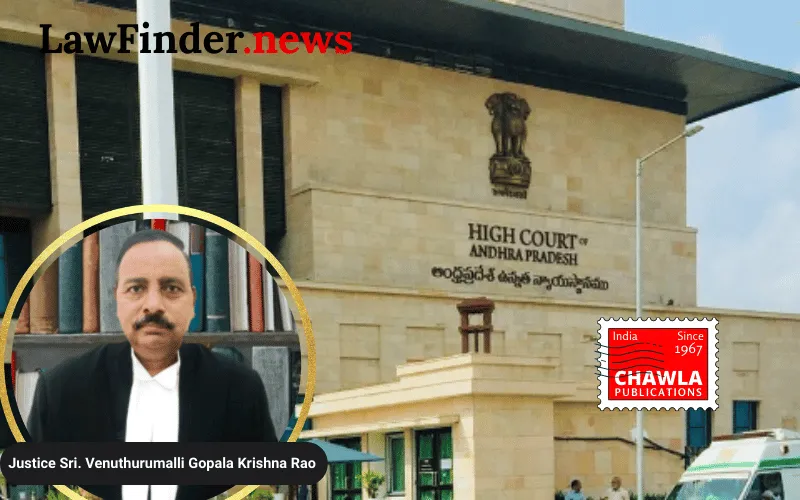
The Andhra Pradesh High Court, presided over by Justice Venuthurumalli Gopala Krishna Rao, delivered a significant judgment affirming the rights of plaintiffs in a complex family partition suit. The case, T. Satyanarayana v. Turangi Somaraju, revolved around the legitimacy of children and their entitlement to ancestral property, a matter that has captured attention due to its intricate family dynamics and legal implications.
The case was initiated when plaintiffs, children of the deceased plaintiff No.1, sought partition of ancestral properties against the defendant, their stepbrother from the first marriage of their father. The properties in question included a vacant site and a house located in Kakinada, Andhra Pradesh. The plaintiffs claimed legitimacy and equal rights to the ancestral properties, a claim initially dismissed by the trial court but later upheld by the first appellate court, prompting the defendant to file a second appeal.
Justice Rao emphasized the principles governing second appeals under Section 100 of the Civil Procedure Code, 1908, which mandates that such appeals can only be entertained if they raise substantial questions of law. The court reaffirmed that mere disputes over evidence or factual findings do not constitute substantial questions of law, thus upholding the first appellate court's decision.
The court meticulously examined the legitimacy of the plaintiffs, confirming their status as legitimate children of plaintiff No.1 and his second wife, Raghava. The defendant's challenge to this legitimacy was undermined by his failure to respond to pre-suit legal notices and his inability to refute the evidence presented by the plaintiffs.
Central to the dispute was a contested relinquishment deed, which the defendant claimed barred the plaintiffs from claiming their shares. The court, however, noted that the defendant failed to produce the deed in court or prove its validity, thereby weakening his defense. The court held that even if the relinquishment deed were valid, it could only affect the share of the signatory, not the entire property.
The court also addressed the procedural aspects concerning the inclusion of the second wife as a legal representative following the death of the original plaintiff. The court confirmed that her inclusion was proper and aligned with the provisions of the Indian Evidence Act, ensuring her entitlement to the deceased plaintiff's share.
Concluding the judgment, Justice Rao dismissed the second appeal, affirming the decision of the first appellate court to partition the properties among the legitimate heirs, thereby setting a precedent in family property disputes involving legitimacy and ancestral rights.
Bottom line:-
A second appeal under Section 100 of the Civil Procedure Code (CPC) can only be entertained if it raises a substantial question of law. Mere appreciation of facts or evidence does not amount to a substantial question of law.
Statutory provision(s): Civil Procedure Code, 1908 Section 100, Hindu Marriage Act, 1955 Section 16, Evidence Act, 1872 Section 67
T. Satyanarayana v. Turangi Somaraju, (Andhra Pradesh) : Law Finder Doc id # 2924790