Supreme Court Sets Aside NCLAT's Delay Condonation in Angelwoods Resolution Plan Appeal, Apex Court Criticizes NCLAT for Overlooking Procedural Compliance in Insolvency Appeal Filing
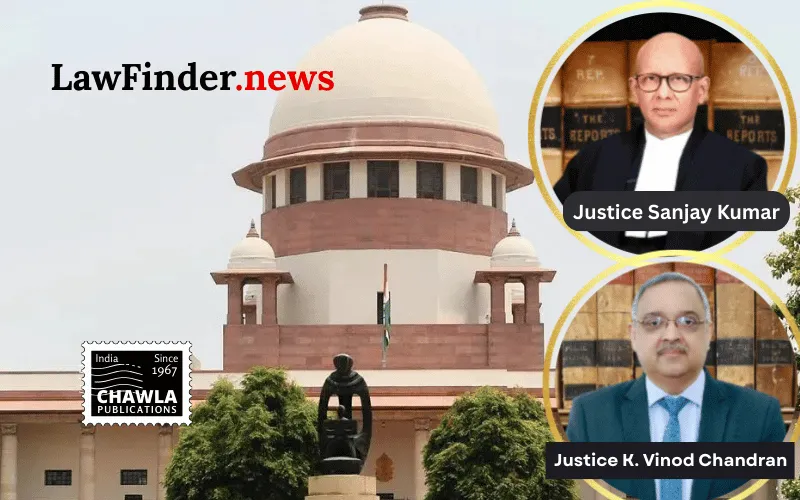
In a significant ruling, the Supreme Court of India has overturned the National Company Law Appellate Tribunal's (NCLAT) decision to condone delays in the filing and refiling of an appeal by M. Lalitha against the approval of a resolution plan involving Angelwoods Apartment Allottees Association. The judgment, delivered by Justices Sanjay Kumar and K. Vinod Chandran, underscores the importance of adhering to procedural norms under the Insolvency and Bankruptcy Code, 2016, and the NCLAT Rules, 2016.
The crux of the matter involved the appeal filed by M. Lalitha, the mother of a suspended director of Samson and Sons Builders and Developers Pvt. Ltd., who challenged the resolution plan sanctioned by the National Company Law Tribunal (NCLT), Kochi Bench, on August 14, 2024. Lalitha's appeal was e-filed on September 28, 2024, the last permissible day under the Code, but was flagged for multiple defects by the NCLAT Registry. Among the defects was the absence of a certified copy of the impugned order-a mandatory requirement under Rule 22(2) of the NCLAT Rules.
Despite the procedural shortcomings, the NCLAT condoned a 150-day delay in refiling the appeal, upon Lalitha's deposit of Rs. 50,000 with the Prime Minister's Relief Fund. This leniency was granted without verifying compliance with essential procedural requirements, a decision the Supreme Court has now deemed improper.
The Supreme Court's judgment highlights the necessity for litigants to apply for and submit certified copies of orders within the limitation period. It criticizes Lalitha for applying for the certified copy only on April 21, 2025, well after the refiling of the appeal on March 10, 2025. Furthermore, the Court notes the absence of any application for exemption from filing the certified copy, a step which could have been considered under Rules 14 and 15 of the NCLAT Rules.
Referring to precedents set in the cases of V. Nagarajan v. SKS Ispat and Power Limited and Ebix Singapore Private Limited v. Committee of Creditors of Educomp Solutions Limited, the Supreme Court emphasized that strict timelines under the Insolvency and Bankruptcy Code are crucial and must be adhered to diligently. The Court found the appeal filed by Lalitha to be "incurably tainted," warranting its rejection at the threshold due to non-compliance with statutory requirements.
This decision reinforces the judiciary's stance on maintaining procedural integrity in insolvency proceedings and serves as a reminder of the critical importance of adhering to statutory provisions for litigants seeking recourse under the Insolvency and Bankruptcy Code.
Bottom Line:
Filing of appeal under Section 61 of the Insolvency and Bankruptcy Code, 2016 must comply with strict timelines and procedural requirements, including submission of certified copy of the impugned order, as mandated under Rule 22(2) of the NCLAT Rules, 2016.
Statutory provision(s): Section 61 of the Insolvency and Bankruptcy Code, 2016, NCLAT Rules, 2016 Rule 22(2), Rules 14 and 15
Angelwoods Apartment Allottees Association v. M. Lalitha, (SC) : Law Finder Doc id # 2897041