Court emphasizes on exhausting alternative statutory remedies under SARFAESI Act before invoking writ jurisdiction
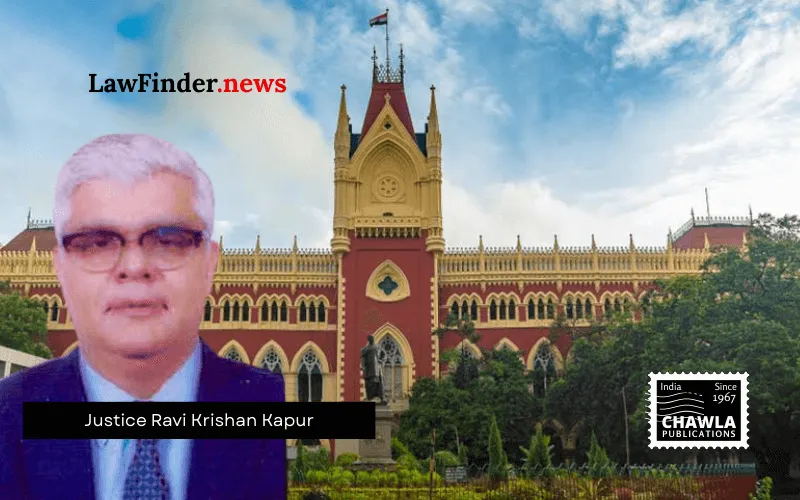
In a significant ruling, the Calcutta High Court, presided over by Justice Ravi Krishan Kapur, dismissed a writ petition filed by M/S R.S.H.S Impex Private Limited against the Union of India and others, including the State Bank of India. The petitioner sought the issuance of a sale certificate or, alternatively, a refund of the sale consideration with interest, following an auction sale.
The court, in its judgment dated May 21, 2026, underscored the importance of exhausting statutory remedies available under the Securitization and Reconstruction of Financial Assets and Enforcement of Security Interest Act, 2002 (SARFAESI Act) before approaching the High Court under its writ jurisdiction. The petitioner had participated in an auction initiated by the State Bank of India for a property located at 19B, Shakespeare Sarani, Kolkata, after the original borrower defaulted on a loan. Despite being the successful bidder and paying a substantial amount of Rs. 11.41 crores, the issuance of the sale certificate was stalled due to an interim order from the Debts Recovery Tribunal, Kolkata.
Justice Kapur emphasized that the writ jurisdiction should not be exercised unless exceptional circumstances, such as a violation of natural justice or statutory provisions, are evident. The court pointed out that the petitioner had not availed the alternative statutory remedy provided by the SARFAESI Act, notably through the Debts Recovery Tribunal, where the primary proceedings are pending.
The judgment also referenced several precedents, including the Supreme Court's decision in United Bank of India v. Satyawati Tondon, which reinforces the principle that High Courts should refrain from entertaining writ petitions when effective alternative remedies are available, especially in matters involving financial recoveries.
The court noted that the sale certificate's issuance was hindered solely due to the Debts Recovery Tribunal's restraint order, and not due to any arbitrariness or mala fides on the part of the bank. Consequently, the court directed M/S R.S.H.S Impex Private Limited to seek redressal from the Debts Recovery Tribunal, thereby dismissing the writ petition.
The judgment serves as a reaffirmation of the judicial principle that statutory mechanisms must be exhausted before invoking higher judicial powers, thereby maintaining judicial discipline and preventing contradictory decisions.
Bottom line:-
The writ petition under Article 226 of the Constitution cannot be entertained when an efficacious alternative statutory remedy is available under the SARFAESI Act, 2002. The High Court must exercise self-restraint and direct the petitioner to exhaust the statutory mechanism unless exceptional circumstances exist.
Statutory provision(s):
Article 226 of the Constitution of India, Securitization and Reconstruction of Financial Assets and Enforcement of Security Interest Act, 2002
M/S. R.S.H.S Impex Private Limited v. Union of India, (Calcutta) : Law Finder Doc id # 2903258