Supreme Court Acquits Gandadhipa Sahu in Dowry Harassment Case, Lack of Specific Evidence Leads to Overturning of Conviction Under IPC Section 498A and Dowry Prohibition Act
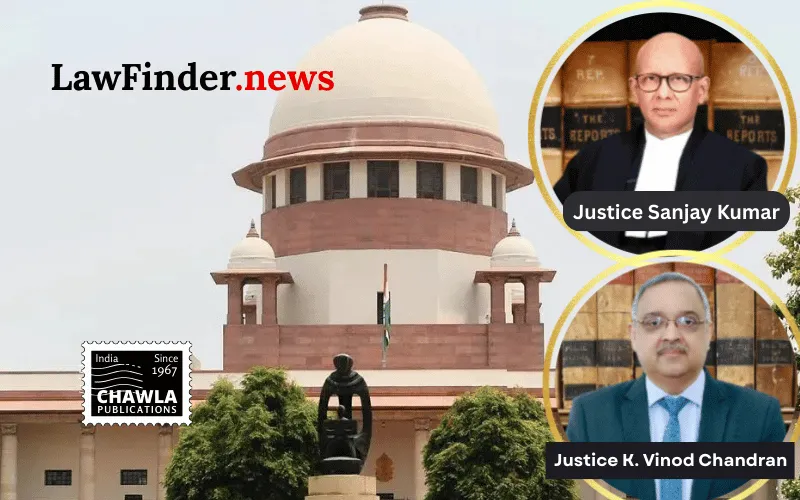
In a significant judgment, the Supreme Court of India has acquitted Gandadhipa Sahu, who was previously convicted under Section 498A of the Indian Penal Code (IPC) and Section 4 of the Dowry Prohibition Act, 1961, citing a lack of specific evidence. The bench, comprising Justices Sanjay Kumar and K. Vinod Chandran, delivered the verdict on May 26, 2026, emphasizing the necessity for concrete evidence to sustain charges of cruelty and dowry demands.
The case originated from allegations that Sahu and his family subjected his wife to continuous harassment and torture over dowry demands, ultimately leading to her suicide. The trial court had convicted Sahu based on general allegations and oral testimonies, sentencing him to three years of rigorous imprisonment under Section 498A and imposing a fine. The High Court later modified the sentence but upheld the conviction.
However, upon appeal, the Supreme Court found that the evidence, primarily consisting of oral testimonies and alleged letters from the deceased, lacked specificity and substantiation. The testimonies were deemed general and omnibus, failing to pinpoint specific instances of cruelty or unlawful demands. The letters, alleged to have been written by the deceased, were not proven to be in her handwriting, further weakening the prosecution's case.
The Supreme Court noted that the trial court's conviction under the Dowry Prohibition Act was inconsistent with its own findings, as no evidence of dowry demands was established. The Court also highlighted discrepancies in the testimonies regarding the mediation efforts and the lack of independent corroboration of the alleged demands.
Justice K. Vinod Chandran, delivering the judgment, underscored the importance of specific evidence to convict an accused under Section 498A of the IPC. The judgment stated, "General and omnibus allegations are insufficient to convict an accused under Section 498A IPC. Specific and substantiated evidence of cruelty or unlawful demands must be presented."
In light of the insufficient evidence, the Supreme Court acquitted Gandadhipa Sahu, reversing the judgments of both the trial court and the High Court. The Court ordered the immediate release of the accused unless detained in connection with any other case.
This judgment reinforces the legal principle that mere allegations without corroborative evidence cannot sustain a conviction under charges of dowry harassment or cruelty, highlighting the judiciary's commitment to upholding the rule of law and ensuring fair trials.
Bottom Line:
Conviction under Section 498A IPC requires specific evidence of cruelty or unlawful demands. General and omnibus allegations without substantiation or proof of specific instances cannot sustain a conviction.
Statutory provision(s): Indian Penal Code, 1860 - Section 498A, Section 304-B; Dowry Prohibition Act, 1961 - Section 4; Probation of Offenders Act, 1958 - Section 4.
Gandadhipa Sahu v. State of Odisha, (SC) : Law Finder Doc id # 2906912