Supreme Court Overturns Dowry Death Conviction in Baboo Khan Case Demand for Gold Ornaments During 'Chhoochhak' Ceremony Not Considered Dowry; Conviction Under IPC Section 498A Upheld
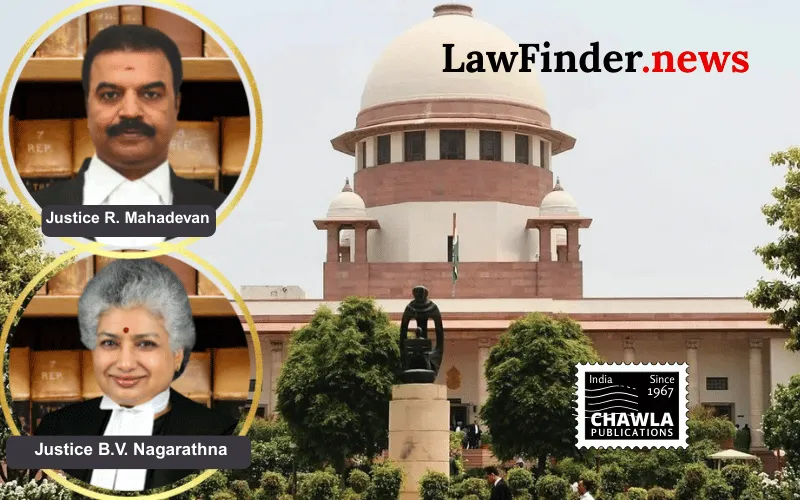
In a significant ruling, the Supreme Court of India has set aside the conviction of Baboo Khan under Section 304B of the Indian Penal Code (IPC), which pertains to dowry death, while sustaining the conviction under Section 498A for cruelty by husband or relatives. The judgment, delivered by Justices B.V. Nagarathna and R. Mahadevan, clarifies the legal interpretation of dowry demands, particularly in cultural contexts such as the 'Chhoochhak' ceremony.
Baboo Khan was initially convicted by the Additional Sessions Judge, Nagaur, for demanding gold ornaments during the 'Chhoochhak' ceremony after the birth of his son, a tradition that the prosecution argued constituted a dowry demand. The High Court of Rajasthan upheld this conviction, leading to Khan's appeal to the Supreme Court.
The Supreme Court, however, found that the demand for gold ornaments in this context was not made in connection with the marriage, which is a crucial element for a demand to be considered dowry under Section 304B IPC. Instead, the demand was related to a customary celebration after childbirth. This distinction led the Court to overturn the conviction under Section 304B, stating that the prosecution failed to prove the demand was connected to the marriage of the parties, aligning with the precedent set in Satvir Singh v. State of Punjab.
Nonetheless, the Court upheld the conviction under Section 498A IPC, recognizing the evidence of cruelty and harassment inflicted upon the deceased. The prosecution successfully demonstrated that Baboo Khan subjected the deceased, Khatoon, to cruelty, which included demands for gold ornaments, thus affirming the one-year sentence under Section 498A.
Baboo Khan has already served a term exceeding the one-year sentence under Section 498A, and the Supreme Court decided against imposing any further incarceration. The Court's interim order had previously granted suspension of sentence and bail to Khan, which is now concluded with the cancellation of bail bonds following this judgment.
The ruling offers clarity on distinguishing cultural practices from legally defined dowry demands, emphasizing the necessity of a direct connection to marriage for charges under Section 304B IPC.
Bottom Line:
The demand for gold ornaments at the time of a customary ceremony after childbirth cannot be considered a dowry demand under Section 304B IPC unless it is connected to the marriage of the parties.
Statutory provision(s): Indian Penal Code, 1860 - Sections 304B, 498A
Baboo Khan v. State of Rajasthan, (SC) : Law Finder Doc Id # 2820605