Supreme Court Upholds Full Disability Pension Arrears for Ex-Servicemen, Landmark Judgment Affirms Right to Disability Pension Without Time Limitation, Citing Constitutional Property Rights
In a landmark judgment, the Supreme Court of India has ruled in favor of ex-servicemen seeking full arrears of disability pension, affirming that such claims cannot be restricted by limitations, delay, or laches. The verdict was delivered in a batch of appeals filed by the Union of India and ex-servicemen, with the Supreme Court unequivocally stating that disability pension is a recurring and enforceable property right under Article 300A of the Constitution of India.
The case, Union Of India v. SGT Girish Kumar, centered around conflicting decisions from the Armed Forces Tribunal regarding the timeframe for which arrears of disability pension should be payable. Some tribunal rulings had limited arrears to three years prior to the filing of applications, while others extended them from specified cut-off dates, namely 01.01.1996 or 01.01.2006.
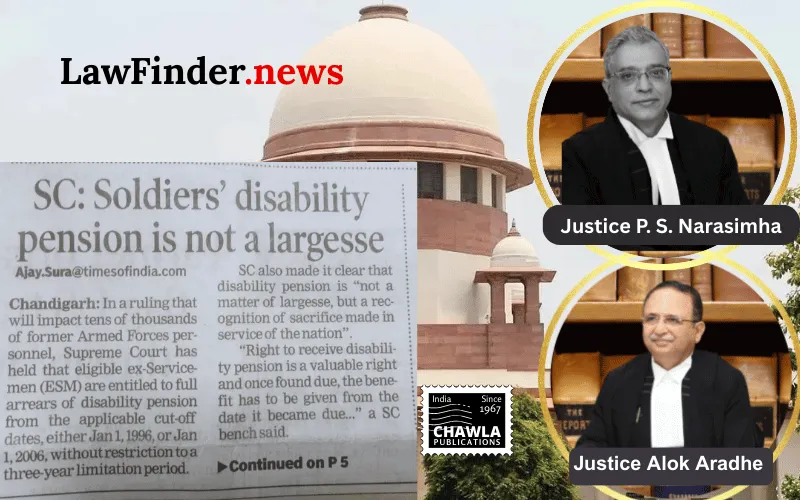
The Court, led by Justices Pamidighantam Sri Narasimha and Alok Aradhe, examined the statutory framework under the Pension Regulations for the Army, 1961 and 2008, and the evolving legal landscape post the decision in Union of India v. Ram Avtar in 2014. The Supreme Court concluded that once entitlement to disability pension is judicially affirmed, arrears cannot be curtailed on the grounds of limitation or delay.
The judgment emphasized that pension, including disability pension, is not a mere bounty but a deferred compensation for past service, recognizing sacrifices made in service to the nation. The Court noted that the Union of India, as a model employer, should administer such benefits fairly and consistently, extending them to all eligible ex-servicemen without requiring individual tribunal applications.
Furthermore, the Court highlighted the Union’s own policy decisions, reflected in government communications, which intended to grant arrears from the cut-off dates of 01.01.1996 or 01.01.2006. It ruled that restricting the payment of arrears to only three years preceding tribunal applications would constitute a deprivation of property and infringe upon Article 300A.
The Supreme Court dismissed the appeals filed by the Union of India against the tribunal orders that directed payment from the prescribed cut-off dates. It allowed the appeals filed by ex-servicemen, quashing tribunal orders that limited arrears to three years before the applications. The Court directed that ex-servicemen should receive their rightful disability pension, with the benefit of broad banding, from 01.01.1996 or 01.01.2006, along with interest at 6% per annum.
This judgment marks a significant victory for ex-servicemen, reinforcing the notion that disability pension is a vested right and ensuring that the sacrifices made in military service are duly acknowledged and compensated.
Bottom Line:
Disability pension entitlement for ex-servicemen cannot be curtailed based on limitation, delay, or laches; arrears must be paid from the prescribed cut-off dates as per judicial affirmation and policy decisions.
Statutory provision(s): Armed Forces Tribunal Act, 2007 Section 30, Pension Regulations for the Army, 1961 and 2008, Article 300A of the Constitution of India, Limitation Act, 1963
Union Of India v. SGT Girish Kumar, (SC) : Law Finder Doc id # 2852628