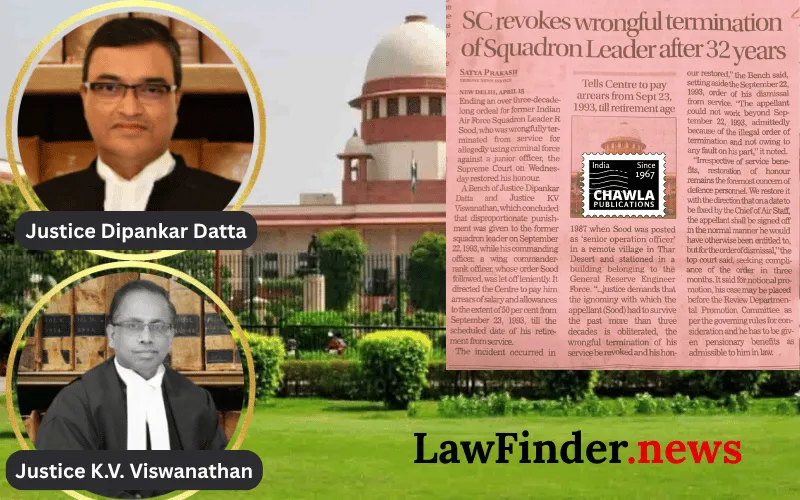
Supreme Court Overturns Wrongful Dismissal, Restores Honour to Ex-Squadron Leader, Supreme Court rules that disciplinary action cannot follow discharge by a criminal court; orders restoration of service benefits and formal sign-off ceremony
In a landmark decision, the Supreme Court of India has quashed the dismissal of Ex-Squadron Leader R. Sood from the Indian Air Force, ordering the restoration of his service benefits and directing a formal sign-off ceremony to restore his honour. The judgment, delivered by Justices Dipankar Datta and K.V. Viswanathan, emphasized that disciplinary action by the Armed Forces cannot be initiated after an accused has been discharged by a criminal court for the same misconduct, as per Section 19 of the Air Force Act, 1950, and Rule 16 of the Air Force Rules, 1969.
Ex-Squadron Leader Sood was dismissed from service in 1993 following an incident involving the alleged misconduct related to the removal of a driver from a camp in the Thar desert, which later resulted in the driver’s death. The Supreme Court noted that Sood was acting under the instructions of his superior officer, who received a comparatively lenient punishment.
The Court held that discharge by a criminal court signifies a lack of evidence even to frame charges and is at a higher pedestal than acquittal. Consequently, the initiation of administrative proceedings against Sood was deemed unjustifiable and non-est in law.
Highlighting the principles of natural justice, the Court criticized the lack of detailed reasoning in the disciplinary proceedings and emphasized the arbitrary nature of the punishment, noting that the commanding officer who issued the orders faced only minor disciplinary action. The Court’s decision underscores the importance of equality and fairness in disciplinary actions within the Armed Forces.
As a result of the judgment, Sood will receive 50% of his salary and allowances from the date of his dismissal until retirement, along with notional promotion and pensionary benefits. The Supreme Court directed that the appellant be accorded a formal sign-off ceremony, ensuring that his service and honour are duly recognized.
Bottom Line:
Disciplinary action by Armed Forces cannot be initiated after an accused has been discharged by a criminal court for the same misconduct under Section 19 of the Air Force Act, 1950, read with Rule 16 of the Air Force Rules, 1969. Discharge is on a better footing than acquittal and precludes subsequent disciplinary action on the same facts.
Statutory provision(s): Air Force Act, 1950 Section 19, Air Force Rules, 1969, Rule 16, Section 121 of the AF Act, Section 124 of the AF Act, Section 227 of the Code of Criminal Procedure, 1973, Section 197 of the Code of Criminal Procedure, 1973
EX. SQN. LDR. R. Sood v. Union of India, (SC) : Law Finder Doc id # 2883276