Supreme Court Stresses on Road Safety and Traffic Law Enforcement in Landmark Judgment Justice A.M. Sapre Committee tasked with addressing cashless treatment for accident victims; UP Amendment Act faces scrutiny over abatement of motor vehicle offence trials.
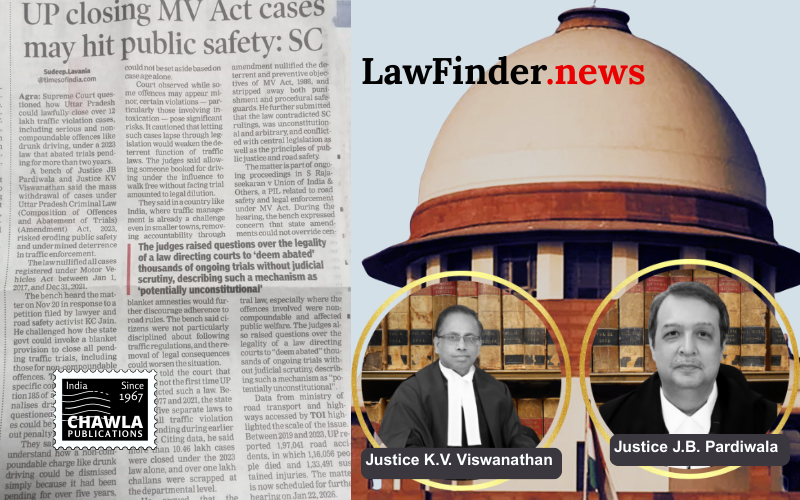
In a significant move aimed at bolstering road safety and reinforcing traffic law enforcement, the Supreme Court of India has delivered a landmark judgment in the case of S. Rajaseekaran v. Union of India. The judgment, delivered by Justices J.B. Pardiwala and K.V. Viswanathan, addresses crucial issues concerning motor vehicle regulations and the enforcement of road safety protocols.
The court has directed the Union of India to deliberate on the reliefs sought for cashless treatment and reimbursement of post-discharge medical expenses for road accident victims. This initiative is to be overseen by the Justice A.M. Sapre Committee, constituted by the court, which is expected to provide its recommendations within six weeks.
A contentious issue in this judgment is the Uttar Pradesh Criminal Law (Composition of Offences and Abatement of Trials) (Amendment) Act, 2023. The Supreme Court raised concerns over the abatement of trials for motor vehicle offences under this Act, emphasizing that such abatement undermines deterrence and public safety. The court has directed the State of Uttar Pradesh to provide a section-wise justification for this abatement.
Justice Pardiwala remarked, "Abatement of proceedings in one shot would take away the sting of deterrence insofar as such offences are concerned." The court highlighted the potential risks of letting offenders of non-compoundable offences, such as driving under intoxication, go unpunished.
Furthermore, the judgment mandates the development and implementation of swift response protocols for road accidents, enhancing highway patrolling and surveillance across states and union territories. The court has granted a six-month timeline for these protocols to be established.
In response to the growing concern over pedestrian safety, the Supreme Court has directed the preparation of comprehensive pedestrian plans, including geospatial mapping and integration of street vendors into footpath designs, to ensure pedestrian safety and compliance with existing laws.
The judgment also touched on the importance of regulatory compliance for drivers' working hours under the Motor Transport Workers Act, 1961, and the Motor Vehicles Act, 1988. The Ministry of Road Transport and Highways has been tasked with ensuring adherence to these provisions.
The Supreme Court's directives in this judgment signify a firm stance on improving road safety measures and ensuring that traffic laws are enforced stringently to protect public safety.
Bottom Line:
The Supreme Court addressed various issues concerning motor vehicle regulations, road safety protocols, and the Uttar Pradesh Criminal Law (Composition of Offences and Abatement of Trials) (Amendment) Act, 2023, emphasizing the need for deterrence in traffic violations and road safety measures.
Statutory provision(s): Motor Vehicles Act, 1988 Sections 162(1), 185; Uttar Pradesh Criminal Law (Composition of Offences and Abatement of Trials) (Amendment) Act, 2023; Constitution of India, Article 254(2), Article 14; Street Vendors (Protection of Livelihood & Regulation of Street Vending) Act, 2014.
S.Rajaseekaran v. Union of India, (SC) : Law Finder Doc Id # 2812183