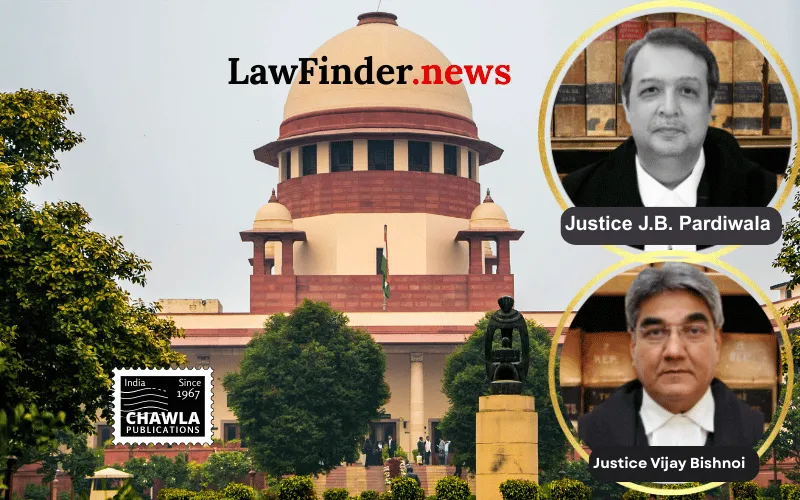
Supreme Court Upholds Telangana High Court's Guidelines for Handling Social Media Cases, Court affirms guidelines to safeguard fundamental rights and prevent arbitrary criminal proceedings in social media-related cases.
In a significant ruling, the Supreme Court of India has upheld the guidelines issued by the Telangana High Court concerning the handling of criminal proceedings related to social media posts. The decision, delivered by a bench comprising Justices J.B. Pardiwala and Vijay Bishnoi, dismissed the Special Leave Petition filed by the State of Telangana, affirming the High Court's guidelines aimed at safeguarding fundamental rights and ensuring compliance with constitutional protections.
The case arose from a batch of criminal petitions wherein the High Court quashed proceedings initiated against the respondents, including Nalla Balu @ Durgam Shashidhar Goud, for offences related to various FIRs registered in Telangana. The Supreme Court's decision reinforces the High Court's operational guidelines for police authorities and Judicial Magistrates, emphasizing the need for a careful and constitutional approach in cases stemming from social media activities.
The guidelines, as delineated in the High Court's judgment, include several critical directives: verifying the locus standi of complainants, conducting preliminary inquiries for cognizable offences, setting a high threshold for media-related offences, and protecting political speech under Article 19(1)(a) of the Constitution. Additionally, defamation is classified as a non-cognizable offence, thereby requiring complainants to approach a Magistrate before police action can be initiated.
Moreover, the guidelines mandate compliance with the arrest principles laid out in the landmark Arnesh Kumar case, stressing the impermissibility of automatic arrests. They also require prior legal scrutiny in politically sensitive cases and call for the closure of frivolous or politically motivated complaints under Section 176(1) of the Bharatiya Nagarik Suraksha Sanhita (BNSS), 2023.
Senior Advocate Mr. Sidharth Luthra, representing the State, acknowledged the merits of the High Court's decision but raised concerns about potential inconsistencies in the guidelines. However, the Supreme Court, after thorough examination, found no grounds to interfere with the High Court's judgment.
This ruling is expected to have a far-reaching impact on how social media-related cases are handled across the country, ensuring that fundamental rights are not compromised and that criminal processes are not invoked mechanically or arbitrarily.
Bottom Line:
Operational guidelines issued by the High Court for police authorities and Judicial Magistrates in handling cases involving social media posts, emphasizing safeguarding fundamental rights, preventing mechanical invocation of the criminal process, and ensuring compliance with constitutional protections.
Statutory provision(s): Section 176(1) of the Bharatiya Nagarik Suraksha Sanhita (BNSS), 2023, Article 19(1)(a) of the Constitution, Section 174(2) of the BNSS.
State of Telangana v. Nalla Balu @ Durgam Shashidhar Goud, (SC) : Law Finder Doc id # 2849245