Court Confirms Judicial Review Limited to Decision-Making Process, Maintains Extension Valid Under Service Rules
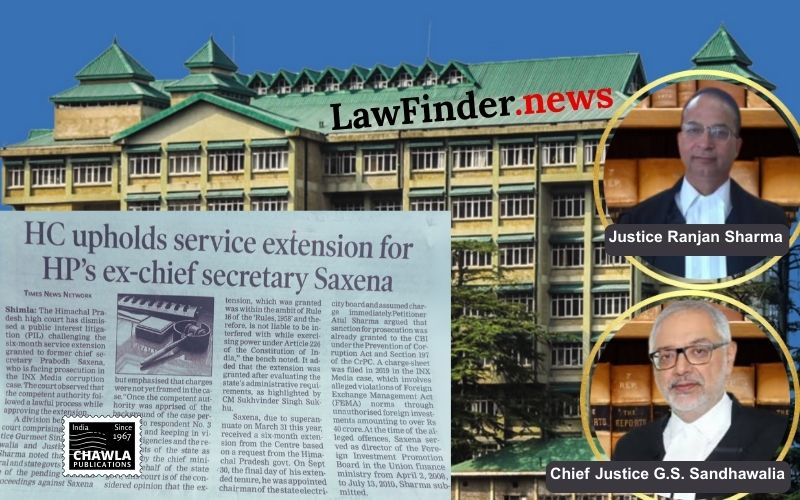
In a significant ruling, the Himachal Pradesh High Court has upheld the six-month service extension granted to Prabodh Saxena, the Chief Secretary of the Government of Himachal Pradesh, despite his involvement in pending corruption charges. The judgment, delivered by the Division Bench comprising Chief Justice Mr. G.S. Sandhawalia and Justice Ranjan Sharma, emphasized the limited scope of judicial review, which is confined to examining the decision-making process rather than substituting administrative discretion.
The case, initiated as a Public Interest Litigation (PIL) by petitioner Atul Sharma, challenged the extension order dated March 28, 2025, which extended Saxena's service from April 1 to September 30, 2025. The petitioner argued that the extension was in violation of service rules and Department of Personnel and Training (DoPT) guidelines, citing a lack of proper vigilance clearance due to the pending criminal proceedings against Saxena under the Prevention of Corruption Act, 1988.
The court, however, maintained the PIL's validity, stating it raised questions of public importance concerning transparency and ethical administration. The doctrine of public trust mandates that public officials act with integrity and accountability, making the PIL maintainable.
The judgment clarified that judicial review in such matters is restricted to verifying whether the competent authority was apprised of all relevant facts and whether the decision-making process adhered to statutory guidelines. The court found that the competent authority, which included the Chief Minister's recommendation, was aware of the criminal proceedings against Saxena but deemed his extension necessary for implementing key state projects and reforms.
Citing Rule 16 of the All India Services (Death-Cum-Retirement Benefits) Rules, 1958, the court noted that Saxena's extension was granted with full justification and in public interest, as required by the rule. The judgment referenced several Supreme Court decisions, affirming that unless the decision is manifestly arbitrary or illegal, the court would not interfere with administrative discretion.
Despite the petitioner’s concerns about Saxena’s integrity, the court concluded that the extension did not violate principles of fair play, transparency, and probity in public administration. The judgment underscored the importance of institutional integrity in appointments to sensitive posts while recognizing the discretionary power of the government in such matters.
The court also addressed the procedural aspect, noting that the competent authority had been properly informed about Saxena’s situation and the extension was not an arbitrary decision. As a result, the court dismissed the writ petition, affirming the service extension's legality.
Bottom Line:
Public Interest Litigation (PIL) challenging extension of service for Chief Secretary accused in corruption case - Maintainability of PIL upheld as appointments to sensitive posts must withstand the test of institutional integrity, transparency, and accountability in governance - Judicial review confined to examining the decision-making process, not substitution of administrative discretion.
Statutory provision(s): Rule 16 of All India Services (Death-Cum-Retirement Benefits) Rules, 1958, Section 19 of the Prevention of Corruption Act, 1988, Section 197 of Cr.PC
Atul Sharma v. Union of India, (Himachal Pradesh)(DB) : Law Finder Doc Id # 2812007