New Delhi, Jun 11 Observing that homemakers should be recognised as "nation builders", the Supreme Court on Thursday held that loss of wife's domestic care should be monetised at a minimum of Rs 30,000 per month.
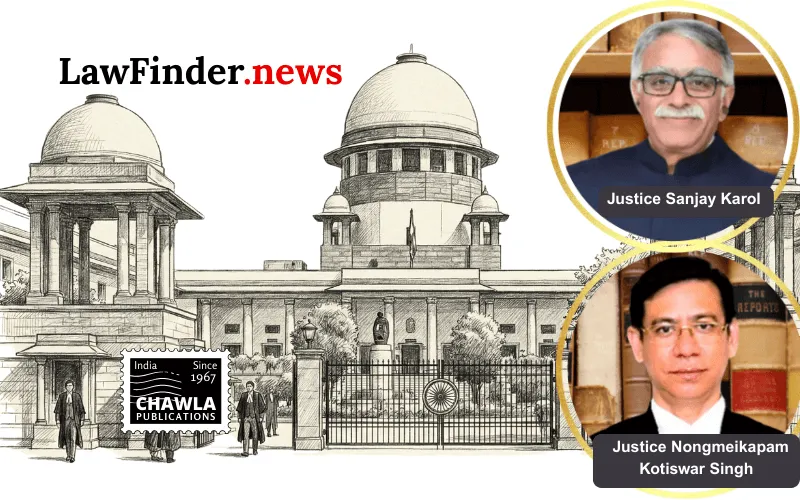
In a judgment with wide implications on cases related to the Motor Vehicles Act, a bench of Justices Sanjoy Karol and N Kotiswar Singh passed the order while granting additional compensation to a man for the loss of his wife in a motor vehicle accident case.
"We are also of the view that the housewife contributes to the growth of the human being and the nation. The homemaker builds nation. So we have laid down the principles, and as a nation builder, we have housewife, we have quantified the amount that the loss of domestic care monthly income minimum in any event would be 30,000 per month," the bench said.
Compensation for deceased homemakers was earlier decided by assigning them a notional income based on prevailing minimum wages while treating them at par with skilled or unskilled workers.
The top court said it is ironic to describe a homemaker as dependent on earning members, when, in reality, the household's functioning depends substantially on the homemaker.
"It is our hope that the word housewife/homemaker, is in future, in recognition of the contributions of the lady of the house is now used as 'Nation Builder'...
"The earning members are in fact solely dependent on the homemaker, but alas, this reality does not receive the acknowledgement it deserves. Efforts have been made across fields to some success but yet undeniably the road is still long," the bench said.
Quoting economist Sir Cecil Pigou, the top court said, "the services rendered by women enter into the dividend when they are rendered in exchange for wages, whether in the factory or in the home, but do not enter into it when they are rendered by mothers and wives gratuitously to their own families. Thus, if a man marries his housekeeper or his cook, the national dividend is diminished.”
The apex court said women's unpaid caregiving work is estimated to contribute 15-17 per cent of India's GDP, yet it remains unpaid and unrecognised.
"Apart from the fact that contribution of women to the society extends far beyond biological reproduction, they are also largely responsible for the preparation of human capital on which the dreams of being the world’s largest economy, among other things, rest.
"The 'homemakers', to put it directly, actually are the 'nation builders' and they ought to be recognised as such," the bench said.
Voicing concern over the delay in cases of motor accident compensation claims, the top court said such matters should be decided within one year.
It asked the chief justices of all the high courts to monitor the progress of cases related to the Motor Vehicles Act.
"The Chief Justices of the High Courts are requested to issue necessary directions to have matters that have remained pending for the longest amount of time, listed according to the date of institution of the appeal, before the appropriate benches.
"The average taken for such purposes is any case that has remained pending for more than four years. For clarity, it may be stated that if matter 'a' has been pending for eight and a half years and 'b' has been pending for four years, 'a' will be listed first," the bench said.
The top court's judgement came on an appeal relating to a motor accident claim in Punjab where a woman named died in a road accident on November 25, 2001.
The husband and three children of the deceased approached the Motor Accident Claims Tribunal seeking compensation, which granted them Rs 2.42 lakh.
Being aggrieved, the claimants approached the Punjab and Haryana High Court seeking enhancement of the amount.
The high court enhanced the compensation to Rs. 8.43 lakh along with 7.5 per cent interest.
Still dissatisfied, the claimants approached the top court.
Shishu Pal @ Shish Ram v. Surjeet, (SC) : Law Finder Doc Id # 2921176