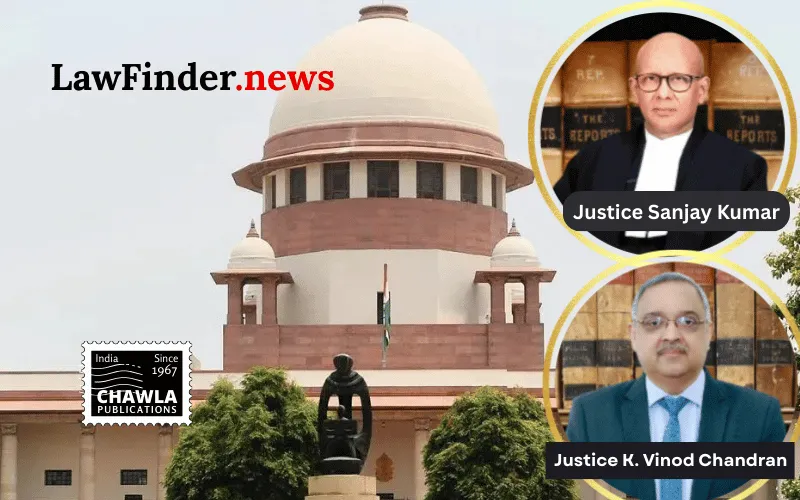
Supreme Court Restores Insolvency Application Against Ecstasy Realty Pvt. Ltd., NCLT and NCLAT's Decisions Overturned; Debenture Trust Deed's Terms Reaffirmed by Apex Court
In a significant ruling, the Supreme Court of India has overturned the decisions of the National Company Law Tribunal (NCLT) and the National Company Law Appellate Tribunal (NCLAT) in the case of Catalyst Trusteeship Ltd. v. Ecstasy Realty Pvt. Ltd. The Apex Court restored the insolvency application filed by Catalyst Trusteeship Ltd., acting as the debenture trustee, under Section 7 of the Insolvency and Bankruptcy Code, 2016.
The case revolves around the issuance of 850 redeemable non-convertible debentures valued at Rs. 850 crore by Ecstasy Realty Pvt. Ltd. to fund a real estate project in Mumbai. Despite the issuance of Series A debentures worth Rs. 600 crore, a restructuring proposal by the respondent company and Edelweiss group entity, ECL Finance Limited, led to a dispute over loan repayment terms.
The Supreme Court, led by Justices Sanjay Kumar and K. Vinod Chandran, criticized the NCLT and NCLAT for dismissing the application based on assumptions of a moratorium and restructuring proposal. The Court emphasized that the adjudicating authority's role under Section 7 is confined to verifying the existence of financial debt and default, dismissing the relevance of pre-existing disputes in such financial creditor applications.
The Court further highlighted that any modification to the Debenture Trust Deed (DTD) necessitated strict compliance with its terms, including obtaining written consent from all parties. The unilateral actions by ECL Finance Limited, without express authorization from other debenture holders and the debenture trustee, were deemed insufficient to alter the DTD's terms.
The Supreme Court's judgment underscores the importance of adhering to contractual procedures and protects the interests of financial creditors under the Insolvency and Bankruptcy Code. The case has been sent back to the NCLT for admission, with directions for necessary proceedings to follow.
Bottom Line:
Application under Section 7 requires the adjudicating authority to examine if a financial debt exists and if there is default in relation thereto - Pre-existing disputes have no bearing in such applications unlike under Section 9 of the Code - Terms of a Debenture Trust Deed (DTD) cannot be modified without following the procedure prescribed therein, including obtaining requisite approvals and written consent.
Statutory provision(s):
Insolvency and Bankruptcy Code, 2016 - Sections 7, 62; Indian Contract Act, 1872 - Section 62.
Catalyst Trusteeship Ltd. v. Ecstasy Realty Pvt. Ltd., (SC) : Law Finder Doc id # 2857757