Supreme Court Quashes SP's Directive for Further Investigation Without Judicial Approval, Apex Court Reiterates the Necessity of Judicial Oversight in Ordering Further Investigations
In a significant ruling, the Supreme Court of India has set aside directives issued by the Superintendent of Police for further investigation in a case without the necessary judicial oversight. The Court emphasized that any further investigation under Section 173(8) of the Criminal Procedure Code, 1973, must be conducted only with prior permission from the Magistrate or the concerned Court.
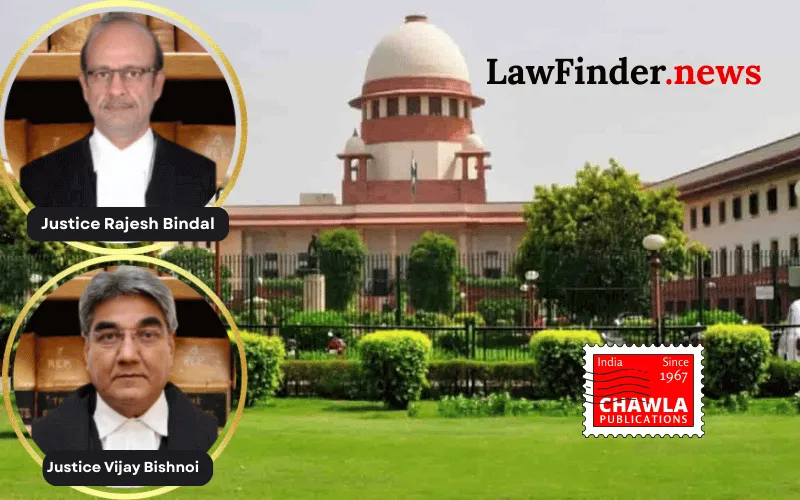
The judgment, delivered by Justices Rajesh Bindal and Vijay Bishnoi, arose from an appeal by Pramod Kumar and others against the orders of the State of Uttar Pradesh directing further investigation into a case under Sections 376D, 352, 504, and 506 of the Indian Penal Code, 1860. The case, which dates back to 2013, had initially concluded with a closure report accepted by the Judicial Magistrate in 2015 after the original complainant failed to appear or file objections.
The crux of the appeal was whether further investigation could be ordered without judicial leave after a closure report had been filed and accepted. The Supreme Court unequivocally ruled against the directives issued by the police authorities, reiterating that only the Magistrate or a higher judicial authority possesses the discretion to order further investigation, thus maintaining the integrity of judicial oversight in criminal investigations.
The Court's decision draws heavily on precedent, specifically the judgments in "Vinay Tyagi v. Irshad Ali" and "Vinubhai Haribhai Malviya v. State of Gujarat", which underscore the necessity for judicial approval in further investigations to prevent misuse of power by the police.
In its detailed judgment, the Supreme Court criticized the actions of the Superintendent of Police for bypassing the judicial process, describing it as an exercise of unfettered power and a disregard for established legal procedures. This decision reinforces the doctrine of judicial oversight and ensures that investigation agencies adhere to the procedural propriety mandated by law.
The ruling not only quashes the orders for further investigation but also sets aside the High Court's decision that upheld these directives. Furthermore, the Supreme Court clarified that its judgment should not prejudice any ongoing criminal revision or related proceedings concerning the original FIR.
This landmark judgment underscores the Supreme Court's commitment to upholding the rule of law and ensuring that investigatory processes remain within the framework of judicial scrutiny.
Bottom Line:
Investigation agency cannot conduct further investigation under Section 173(8) CrPC without obtaining prior permission from the Magistrate or the concerned Court, even if a final report has been accepted.
Statutory provision(s): Criminal Procedure Code, 1973 Section 173(8), Bharatiya Nagarik Suraksha Sanhita, 2023 Sections 193(3) and 193(9)
Pramod Kumar v. State of U.P., (SC) : Law Finder Doc id # 2849052