Court reiterates burden on military authorities to provide clear medical reasons for denying disability pensions; emphasizes liberal interpretation in favor of claimants under 1961 and 2008 Pension Regulations
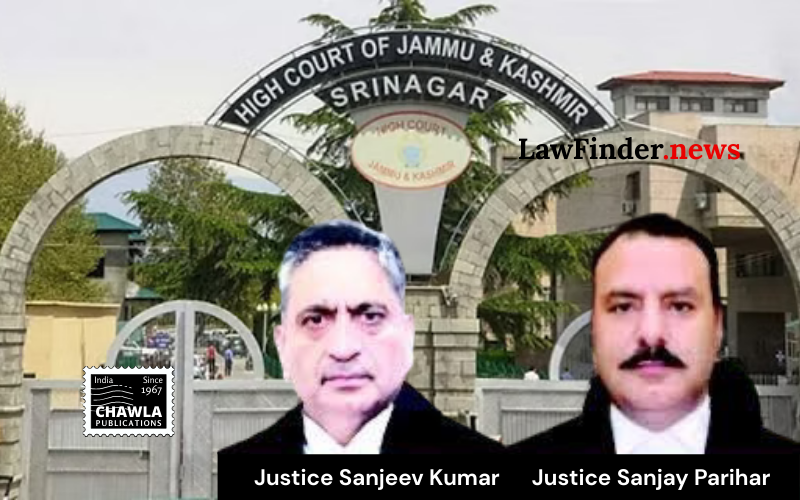
In a landmark judgment delivered on November 3, 2025, the Jammu & Kashmir High Court (Division Bench) dismissed multiple writ petitions filed by the Union of India challenging the orders of the Armed Forces Tribunal (AFT), Srinagar Bench at Jammu, which had upheld claims of disability pensions by several ex-servicemen. The Court affirmed the entitlement of these personnel to disability pensions, emphasizing the need for clear, cogent, and unambiguous medical reasons when denying such claims.
The petitions revolved around the interpretation and application of two sets of pension rules: the Pension Regulations for the Army, 1961 along with the Entitlement Rules for Casualty Pensionary Awards, 1982, and the Pension Regulations for the Army, 2008 with the Entitlement Rules, 2008. These regulations govern the grant of disability pensions to personnel invalided out of military service due to disabilities either attributable to or aggravated by military service.
Key issues before the Court included whether a disability is attributable or aggravated by military service, the presumption of sound physical and mental condition at the time of entry into service, the burden of proof for entitlement, and the adequacy of medical board opinions when denying pensions.
The Court reiterated settled legal principles from landmark Supreme Court rulings, including Dharamvir Singh v. Union of India (2013), Sukhvinder Singh v. Union of India (2014), and Union of India v. Rajbir Singh (2015), which collectively establish the following:
- - A member of the armed forces is presumed to have been in sound physical and mental condition at the time of entry unless noted otherwise.
- - Any deterioration in health leading to discharge on medical grounds is presumed to be due to military service.
- - The burden of disproving this presumption lies on the employer, not the claimant.
- - Medical boards must provide clear and cogent reasons for their opinions, especially when denying attribution or aggravation.
- - Disability assessed below 20% at the time of discharge is to be deemed as 20% for pension purposes when the individual is invalided out of service.
- - Pension regulations and entitlement rules must be construed liberally in favor of ex-servicemen.
In the numerous cases before the Court, the medical boards had assessed various disabilities-such as primary hypertension, ischemic heart disease, diabetes mellitus, obesity, mental disorders, fractures, and cancers-as neither attributable to nor aggravated by military service, often with terse or vague reasons. The Court found these medical opinions insufficient to rebut the presumption favoring the claimants.
The Court highlighted that under the 2008 Entitlement Rules, while the presumption that a disease arose during service is not absolute, the burden remains on the military authorities to provide clear reasons for denial. The Court further noted that environmental and service conditions-including stress, separation from family, postings in high altitude areas, field and counter-insurgency operations-can aggravate certain diseases, and medical boards are required to consider these factors expressly.
In several instances, the Court found that medical boards failed to consider the entire service profile, including postings in stress-prone or challenging environments, and did not furnish detailed reasoning for denial. The Court accordingly upheld the AFT’s direction for disability pensions to be granted, often with the benefit of rounding off the disability percentage to 50% as per the Supreme Court’s precedent in Union of India v. Ram Avtar (2014).
Furthermore, where medical opinions were vague or inconclusive, the Court directed review or re-survey medical boards to re-assess the disabilities with detailed and reasoned opinions consistent with the Guide to Medical Officers (Military Pension), 2008 and related amendments.
The Court also dismissed contentions regarding limitation and procedural technicalities, reiterating that disability pension claims represent continuing causes of action and that pension is a recurring right.
This comprehensive judgment underscores the judiciary’s firm stance on protecting the welfare of ex-servicemen, ensuring that disability pensions are granted in accordance with law and medical evidence, and that the benefit of doubt is given liberally to those who have served the nation.
Bottom Line:
Disability pension entitlement to armed forces personnel invalided or discharged on medical grounds is governed by specific pension regulations and entitlement rules.
Statutory provision(s): Pension Regulations for the Army, 1961; Entitlement Rules for Casualty Pensionary Awards to the Armed Forces Personnel, 1982; Pension Regulations for the Army, 2008; Entitlement Rules for Casualty Pensionary Awards to the Armed Forces Personnel, 2008; Guide to Medical Officers (Military Pension), 1980, 2002 and 2008; Article 226 of the Constitution of India
Union of India v. Nirman Singh Jamwal, (Jammu And Kashmir)(DB) : Law Finder Doc Id # 2804770