Court emphasizes the need for prompt resolution, citing Supreme Court guidelines for a three-month timeframe.
In a significant ruling, the Madhya Pradesh High Court has underscored the necessity for the Speaker of the Madhya Pradesh Legislative Assembly to expedite the decision-making process regarding a petition seeking the disqualification of a legislator. The petition, filed by Umang Singhar, has been pending since June 2024, prompting judicial intervention to ensure compliance with established guidelines.
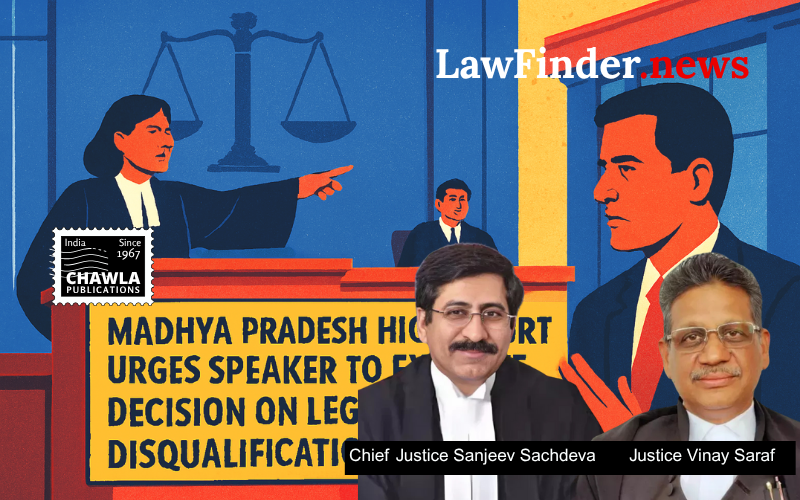
The court, presided over by Chief Justice Sanjeev Sachdeva and Justice Vinay Saraf, referenced the Supreme Court's directives, which advocate for a reasonable period of three months for such petitions to be resolved. This timeframe was highlighted in the case of "Keisham Meghachandra Singh v. Speaker, Manipur Legislative Assembly," which serves as a benchmark for similar matters.
During the proceedings, the petitioner's counsel, Shri Vibhor Khandelwal, argued that despite the passage of several months, the petition remains undecided, which necessitates judicial oversight to ensure adherence to the Supreme Court's guidelines. The delay in decision-making has raised concerns about the potential erosion of legislative accountability and transparency.
The court, however, acknowledged the Speaker's prerogative in deciding the petition, as emphasized by the Advocate General, Shri Prashant Singh, representing the state. The Advocate General contended that judicial review is generally not exercised unless a decision has been made by the Speaker. This stance aligns with the principle of separation of powers and respects the autonomy of legislative processes.
In response to the situation, the High Court has issued notices to the relevant respondents, including the State of Madhya Pradesh, with a returnable date set for November 18, 2025. This move is aimed at expediting the resolution process and ensuring that the legislative framework operates within the confines of judicially established timelines.
The court's decision highlights the ongoing challenge of balancing legislative independence with judicial oversight, particularly in matters that directly impact the functioning of democratic institutions. As the case progresses, it underscores the critical need for procedural efficiency and accountability in legislative assemblies across the country.
Bottom Line:
Petition seeking disqualification of a legislator filed before the Speaker of Legislative Assembly must be decided expeditiously, adhering to the reasonable period of three months as laid down by the Supreme Court.
Statutory provision(s): Constitution of India