A landmark judgment clarifies the rights of children from void marriages over ancestral property under Hindu Marriage and Succession laws.
In a significant judgment, the Madras High Court, Madurai Bench, delivered a nuanced ruling in the partition suit involving the descendants of Duraisamy Udaiyar. The case, Annapottu Ammal v. Tamilmani, revolved around the determination of property rights among legitimate and illegitimate heirs under the Hindu Marriage Act, 1955, and the Hindu Succession Act, 1956.
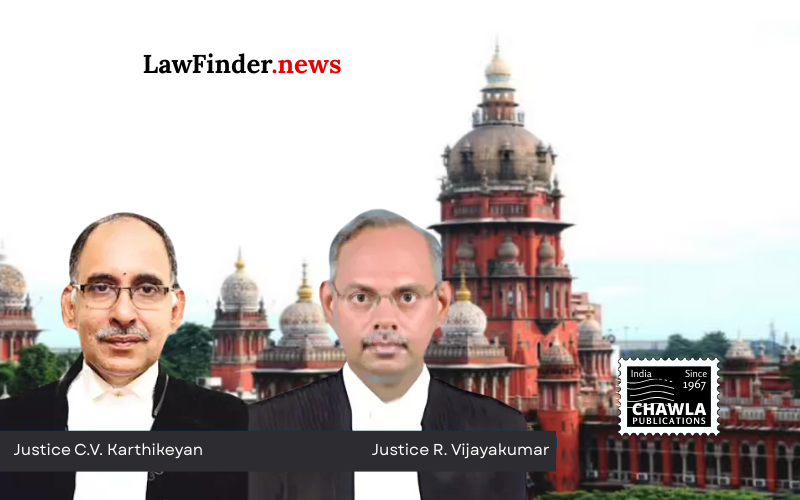
The judgment, pronounced on November 14, 2025, by Justices C.V. Karthikeyan and R. Vijayakumar, tackled complex issues of legitimacy and inheritance rights. Duraisamy Udaiyar, the deceased, had two wives and multiple children from both marriages. The central legal contention was the validity of the second marriage to Gandhimathi Ammal, which was alleged to be void due to bigamy, and the consequent property rights of the children from this marriage.
The court meticulously analyzed Sections 16(1) and 16(3) of the Hindu Marriage Act, which confer legitimacy on children born from void marriages but restrict their rights to ancestral property. The court upheld the principle that while children from void marriages are deemed legitimate, their property rights are limited to the share of their parents, barring claims over the ancestral property of others.
Referring to the Supreme Court's decision in Revanasiddappa v. Mallikarjun, the bench elucidated that legitimacy under Section 16 does not equate to equal property rights across all family assets. The ruling emphasized that children from void marriages can inherit their parents' share in ancestral property but are barred from claiming independent rights in such properties.
The judgment further delineated the partition of properties between the heirs of Duraisamy Udaiyar. It confirmed the trial court's finding that several properties were self-acquired by the deceased, while others were ancestral. The court allocated specific shares to the legitimate heirs and also recognized the entitlements of children from the void marriage in their father's property.
This ruling brings clarity to the interpretation of legitimacy and inheritance rights under Hindu law, particularly concerning void marriages and ancestral properties. Legal experts view this judgment as a crucial reference for similar cases, marking a pivotal moment in the jurisprudence of family law in India.
Bottom Line:
Partition suit concerning ancestral and self-acquired properties of Duraisamy Udaiyar - Determination of shares among legitimate and illegitimate heirs under Hindu Marriage Act and Hindu Succession Act - Legitimacy under Section 16(1) of Hindu Marriage Act does not grant rights in ancestral properties except through parents.
Statutory provision(s): Hindu Marriage Act, 1955 - Section 16, Hindu Succession Act, 1956 - Section 8
Annapottu Ammal (died) v. Tamilmani, (Madras)(DB)(Madurai Bench) : Law Finder Doc Id # 2808864