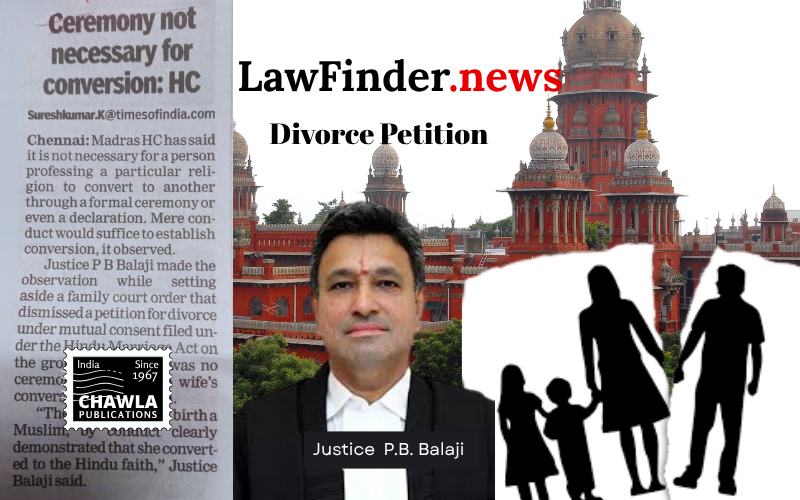
The High Court emphasizes that a person's conduct expressing intention to profess Hindu faith is sufficient for conversion, negating the need for formal ceremonies.
In a landmark judgment, the Madras High Court, under the aegis of Justice P.B. Balaji, has set aside a lower court's dismissal of a divorce petition filed under Section 13(B) of the Hindu Marriage Act, 1955. The case involved a couple seeking a divorce by mutual consent, where the wife was originally a Muslim by birth but had demonstrated conversion to Hinduism through her conduct.
The crux of the issue lay in the Subordinate Judge of Ambattur's decision to dismiss the petition on the grounds that the wife was a Muslim by birth. The lower court had ruled the petition as non-maintainable under the Hindu Marriage Act, which applies to Hindus, Buddhists, Jains, and Sikhs. However, Justice Balaji overturned this decision, emphasizing that the wife's conduct, including her marriage solemnized according to Hindu rites at a Hindu temple, was sufficient evidence of her conversion to Hinduism.
The petitioners had married at the Arulmighu Balamurugan Temple in Chennai, and their marriage was conducted in accordance with Hindu customs. Despite the wife's Muslim birth, her participation in Hindu marriage rites and her assertion of Hindu faith in the divorce petition demonstrated her conversion. Justice Balaji cited the Supreme Court ruling in the case of Perumal Nadar (Dead) by L.R.S v. Ponnuswami, which held that a bona fide intention to convert, coupled with conduct expressing that intention, suffices for religious conversion without the need for formal ceremonies.
Justice Balaji pointed out that the second petitioner had, by conduct, clearly demonstrated her conversion to Hindu faith. The court found that the absence of any formal conversion ceremony was not a valid ground for dismissing the divorce petition. The order of the Sub Judge, Ambattur, was thus set aside, and the matter was remitted for decision on merits.
This judgment underscores the legal recognition of religious conversion through conduct, aligning with the Supreme Court's stance that a formal ceremony is not a requisite for conversion. The case highlights the broader implications for individuals who, through personal conduct, profess a different faith than the one they were born into.
Bottom Line:
Hindu Marriage Act, 1955 - Conversion to Hinduism - A person's conduct unequivocally expressing intention to profess Hindu faith is sufficient evidence for conversion - No formal ceremony of purification or declaration is required.
Statutory provision(s): Hindu Marriage Act, 1955 Section 13(B)