New Delhi, May 13 Underlining that majoritarianism cannot trump constitutionalism in a constitutional democracy, the Supreme Court on Wednesday said courts can interfere if practices violate "public order, morality or health".
The Centre submitted that the scope of judicial review in religious matters is very restricted and such issues should be left to the legislature.
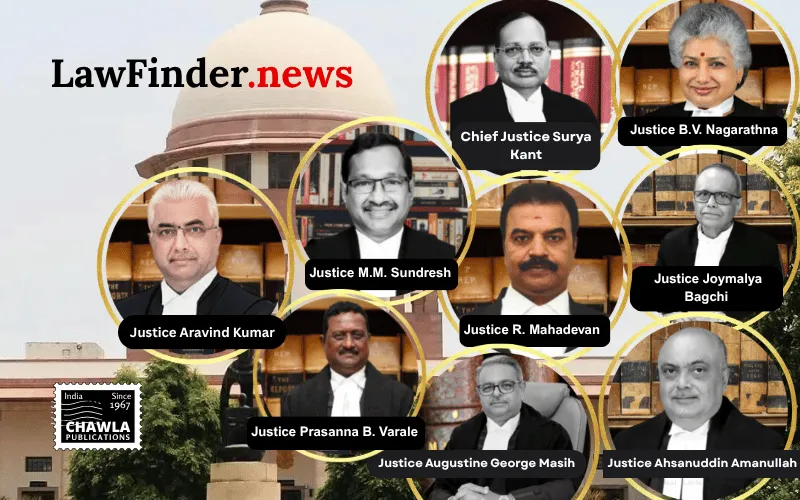
The observation of a nine-judge Constitution bench headed by Chief Justice of India Surya Kant came while hearing petitions related to discrimination against women at religious places, including the Sabarimala temple in Kerala, and on the ambit of religious freedom practised by multiple faiths, including Dawoodi Bohras.
Justices B V Nagarathna, M M Sundresh, Ahsanuddin Amanullah, Aravind Kumar, Augustine George Masih, Prasanna B Varale, R Mahadevan and Joymalya Bagchi are also part of the nine-judge bench.
Submitting his rejoinder arguments on the 15th day of hearing, Solicitor General Tushar Mehta, appearing for the Centre, submitted that the legislature is always conscious of evil things going on in society.
"Religion reforms from within. As in the case of the "Sati" practice which was a social evil, we reformed. The question is, can the court act as a reformer of religion?
"My respectful and unapologetic answer would be a no. The reason is that the constitutional scheme entrusts the reform part to the Legislature...," Mehta said.
He said before passing of a law, there is a detailed practise, where the select committee invites experts from various fields and there is a consultative process.
"Each and every citizen of this country is present in Parliament through its representative and when a law is passed its acceptability is much more than a judicial verdict. Therefore, the Parliament has left reform to the State," Mehta submitted.
Disagreeing with Mehta's statement, Justice Amanullah said the submission that religious issues should be left to the legislature is not acceptable.
"That means sheerly because of majoritarianism… we should not?" Justice Amanullah said.
Surpised at Justice Amanullah's remark, Mehta questioned the use of the word "majoritarianism".
"I am sorry. It is democracy. Democracy means majority," Mehta said.
This prompted Justice Bagchi to intervene and say, "It is not majoritarianism which the court is bothered about. The court is essentially bothered about majoritarianism trumping constitutionalism and that is the 'lakshman rekha'.
"We are committed to a democracy which is definitely a test of numbers, but we are also a constitutional democracy. So even if a majority feels that a particular thing is to be done, the courts have that role to test that decision from the constitutional principles," Justice Bagchi observed orally.
Justice Nagarathna said a court cannot strike down a religious practise or a religious custom in a writ petition under Article 32 of the Constitution which would be an "erroneous approach".
Mehta argued that any judicial scrutiny by the court cannot proceed only on the constitutional understanding of Articles 14 or Article 21 of the Constitution or whether there is discrimination and if the constitutional test is satisfied.
The solicitor general told the court that judicial review has to proceed from the perspective of a person who follows the religion and possesses a belief system protected by the Constitution.
Senior advocates C S Vaidyanathan, Abhishek Singhvi, Indira Jaising, Neeraj Kishan Kaul, Gopal Sankaranarayanan also made submissions in the matter.
The hearing will resume on Thursday.
Observing that Hinduism is a way of life, the top court earlier in the day said it is not necessary for a Hindu to mandatorily go to a temple or perform a ritual in order to remain a Hindu. Even lighting a lamp inside the house is enough to prove one's belief, it said.
Advocate Dr G Mohan Gopal, appearing for Kerala-based Sree Narayana Manavadharman Trust, submitted that there has been a demand for social justice emerging from within religious communities.
"Hinduism was defined as a religious category. Thereafter, in 1966, it was held that a Hindu is one who accepts the Vedas as the highest authority in all matters of religion and philosophy.
"They never asked me. None of us ever said that," Gopal said.
The advocate said he now had the highest respect for the Vedas and great admiration for them.
"But is it a fact that every person today classified as Hindu accepts the Vedas as the highest authority in all spiritual and philosophical matters?" he asked.
Responding to his submission, Justice Nagarathna said, "That is why Hinduism is called 'a way of life'. It is not necessary for a Hindu to mandatorily go to a temple or perform a ritual in order to remain a Hindu."
She said one need not be ritualistic and nobody can come in the way of people having their faith.
The CJI also remarked, "Even if an individual lights a lamp inside his hut, it is enough to prove his religion."
The hearing is underway.
The top court had earlier observed that if individuals start questioning every religious practice or matters of religion before a constitutional court, then there will be hundreds of petitions and every religion will "break" due to this.
A five-judge Constitution bench had lifted a ban that prevented women between the ages of 10 and 50 from entering the Sabarimala Ayyappa temple in a 4:1 majority verdict in September 2018, ruling that the centuries-old Hindu religious practice was illegal and unconstitutional.