Chhattisgarh High Court Quashes Residence-Based Reservation in PG Medical Courses Rules Violating Article 14 Deemed Unconstitutional; Institutional Preference Upheld
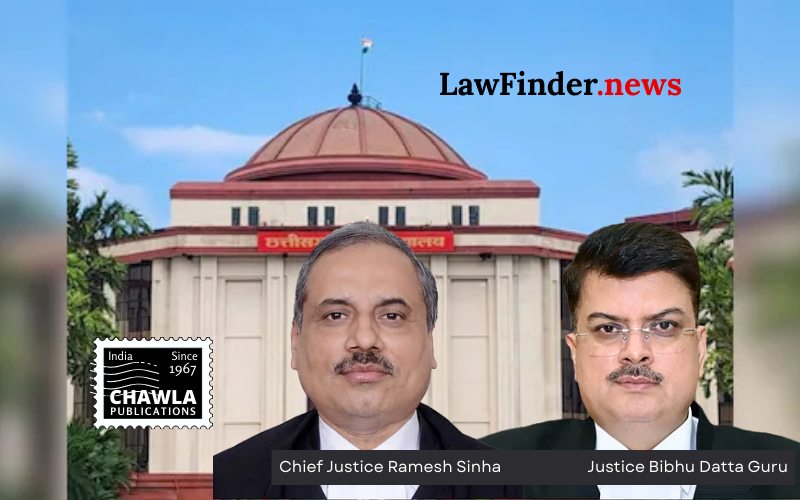
In a significant ruling, the Chhattisgarh High Court has struck down the residence-based reservation provisions in the Chhattisgarh Medical Post Graduate Admission Rules, 2025, declaring them unconstitutional and violative of Article 14 of the Indian Constitution. The court was presided over by Chief Justice Mr. Ramesh Sinha and Justice Bibhu Datta Guru, who delivered the judgment on November 20, 2025.
The case, titled Dr. Samriddhi Dubey v. State of Chhattisgarh and Others, revolved around the contentious Rule 11(a) and 11(b) of the 2025 Admission Rules. These rules provided preferential admission in PG medical courses to candidates who either obtained their MBBS degree from medical colleges in Chhattisgarh or were serving candidates in the state, and to those who were natives of Chhattisgarh but had completed their MBBS from outside the state.
The petitioner, Dr. Samriddhi Dubey, challenged the constitutionality of these rules, arguing that they unfairly discriminated against candidates based on their residence and institutional affiliation, thereby breaching the equality clause enshrined in Article 14 of the Constitution. Represented by Senior Advocate Mr. Rajeev Shrivastava, Dr. Dubey contended that such discriminatory practices were impermissible in postgraduate medical admissions, as established by precedents from the Supreme Court.
The court referred to landmark judgments such as Pradeep Jain v. Union of India and Saurabh Chaudri v. Union of India, which clearly delineate that residence-based reservations are not permissible in PG medical courses due to their infringement on the fundamental right to equality. The Supreme Court had previously held that while institutional preference could be justified within reasonable limits, residence-based discrimination was not allowed.
The Deputy Advocate General for the state, Mr. Shashank Thakur, defended the rules, stating that they were crafted to regulate admissions within the state quota effectively. However, he acknowledged the Supreme Court's stance against residence-based reservations and conceded that the institutional preference was the primary focus of the revised rules.
In its judgment, the Chhattisgarh High Court emphasized the importance of merit-based admissions in PG medical courses, underscoring the need for equality in educational opportunities across the country. The court directed that admissions should strictly adhere to merit as determined by the National Eligibility cum Entrance Test (NEET) results, without any residence-based bias.
The ruling aligns with the decision of the Madhya Pradesh High Court in a similar case, Sawan Bohra v. State of M.P., which also quashed domicile-based reservations in PG medical admissions. The Chhattisgarh High Court's decision is expected to influence similar policies across other states, promoting a uniform merit-based approach to higher medical education.
The judgment marks a pivotal moment in the realm of educational policy, reinforcing the constitutional guarantee of equality and ensuring that PG medical admissions remain fair and meritocratic.
Statutory provision(s): Article 14 of the Constitution of India, Chhattisgarh Medical Post Graduate Admission Rules, 2025, Rules 11(a) and 11(b)
Dr. Samriddhi Dubey v. State of Chhattisgarh, (Chhattisgarh)(DB) : Law Finder Doc Id # 2811313