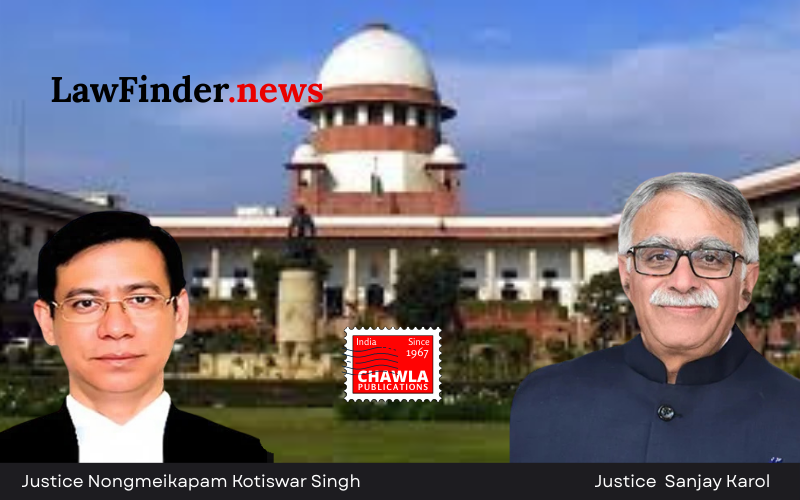
Supreme Court Quashes High Court's Bail Order, Stresses Parity Not Sole Ground for Bail The Supreme Court sets aside bail granted to accused Rajveer and Prince, emphasizing the need to evaluate the accused's role and relevant factors beyond parity with co-accused.
In a landmark decision, the Supreme Court of India has quashed the bail order granted by the Allahabad High Court to accused Rajveer and Prince in the murder case of Sonveer. The apex court underscored that parity with co-accused cannot be the sole ground for granting bail, emphasizing the necessity to consider the role of the accused and other relevant factors.
The appeals, filed by Sagar, the appellant-complainant, challenged the High Court’s decision to grant bail to Rajveer and Prince, citing a lack of detailed reasoning and reliance solely on parity. The Supreme Court bench, comprising Justices Sanjay Karol and Nongmeikapam Kotiswar Singh, noted that the High Court's orders failed to reflect an application of mind or an assessment of relevant factors, such as the gravity of the offence and the accused's role.
The case originated from a verbal altercation that escalated into a fatal incident, where the accused, allegedly led by Rajveer, blocked the appellant-complainant and his family, resulting in the shooting of Sonveer. The High Court had granted bail to Rajveer based on parity with another accused, Suresh Pal, who was previously released on bail. However, the Supreme Court had already set aside Suresh Pal's bail, indicating inconsistency in the High Court's application of parity.
The Supreme Court reiterated the principles for granting bail, highlighting that an order should reflect a judicious evaluation of factors like the severity of the offence, potential tampering with evidence, and the accused's criminal antecedents. It criticized the High Court for failing to assign any reasons for Prince's bail and remanded the matter for fresh consideration.
Justice Karol, delivering the judgment, stated, "Parity cannot be the sole ground for granting bail; the role of the accused and other relevant factors must be considered." The court emphasized that the position and role of the accused in the crime are crucial in determining bail, rather than mere involvement in the same offence.
The Supreme Court's decision sends a strong message to lower courts, reinforcing the need for a detailed and reasoned approach in bail applications, especially in serious offences like murder. The judgment is expected to influence future bail considerations, ensuring a more thorough and principled evaluation process.
Bottom Line:
Parity cannot be the sole ground for granting bail; the role of the accused and other relevant factors must be considered while granting bail.
Statutory provision(s): Criminal Procedure Code, 1973