Supreme Court Reinstates Conviction in Kerala Corruption Case, High Court's Acquittal Overturned; Demand and Acceptance of Bribe Established Beyond Doubt
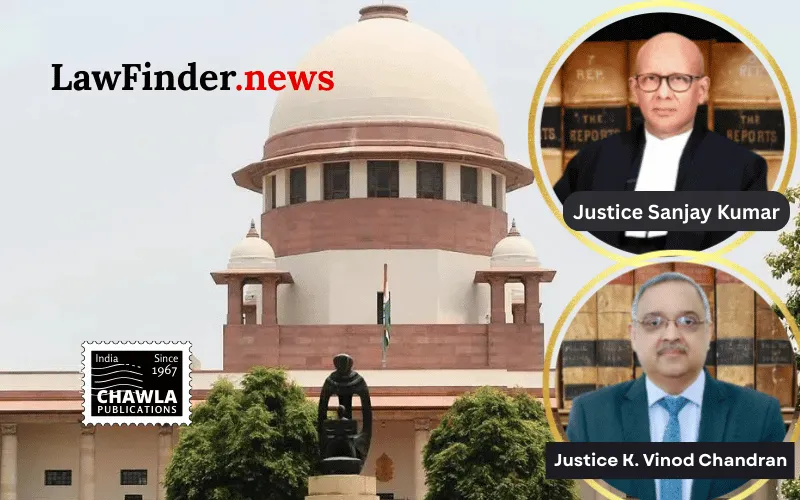
In a significant judgment, the Supreme Court of India has overturned the acquittal of a public servant accused of corruption, reinstating the trial court's conviction. The apex court, comprising Justices Sanjay Kumar and K. Vinod Chandran, delivered its verdict on April 15, 2026, in the case of State of Kerala v. K.A. Abdul Rasheed. The judgment reaffirms the necessity of proving demand and acceptance of illegal gratification to establish corruption charges under the Prevention of Corruption Act, 1988.
The case involved K.A. Abdul Rasheed, a Taluk Supply Officer (TSO) in Kerala, who was accused of demanding a bribe of Rs. 500 for countersigning 'Abstract' registers, a task necessary for the functioning of Authorized Ration Dealers (ARD). The trial court had found Rasheed guilty, sentencing him to two years of imprisonment under Sections 7 and 13(1)(d) of the Prevention of Corruption Act, along with a fine. However, the Kerala High Court subsequently acquitted Rasheed, citing insufficient evidence of demand and acceptance due to the complainant's inconsistent testimony.
The Supreme Court's judgment meticulously analyzed the evidence, especially the testimony of the complainant and the corroborating evidence from independent witnesses and vigilance officers. It was noted that despite the complainant turning hostile, his initial statements, coupled with corroborative evidence, clearly established the demand and acceptance of the bribe.
The court emphasized that the false explanation given by Rasheed regarding the acceptance of the money further pointed to his guilt. The judgment also highlighted the legal principle that the testimony of hostile witnesses could be relied upon if corroborated by other credible evidence.
Justice Vinod Chandran, writing the judgment, observed that the pre-trap and post-trap proceedings provided sufficient corroboration of the complainant's initial allegations. The court criticized the High Court for failing to appreciate the extent of corroborative evidence supporting the complainant's claims.
The Supreme Court restored the trial court's judgment, affirming the statutory minimum sentence prescribed for the offences. The judgment underscores the judiciary's commitment to upholding the rule of law and ensuring accountability in public office.
Bottom Line:
Prevention of Corruption Act, 1988 - Proof of demand and acceptance of illegal gratification by a public servant is a sine qua non to establish guilt under Sections 7 and 13(1)(d) of the Act. Hostile witnesses' testimony can still be relied upon to the extent deemed credible by the court. Demand stands established if supported by corroborative evidence like pre-trap and post-trap proceedings.
Statutory provision(s): Prevention of Corruption Act, 1988 Sections 7, 13(1)(d), 20; Evidence Act, 1872 Section 3
State of Kerala v. K.A. Abdul Rasheed, (SC) : Law Finder Doc id # 2883249