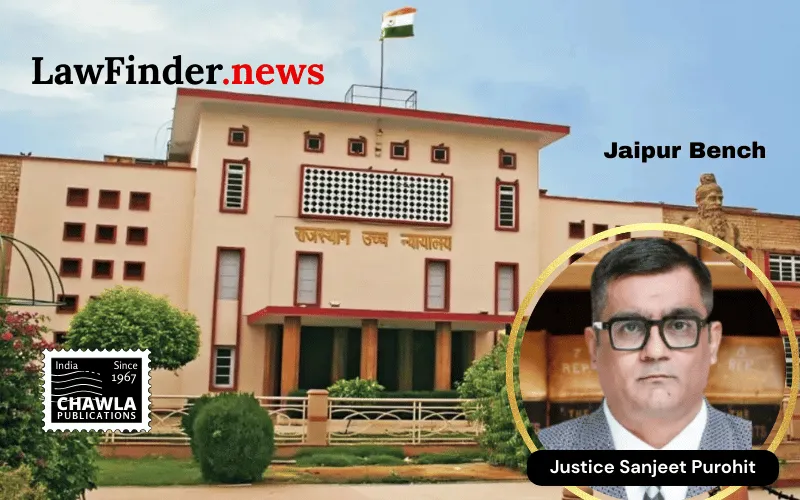
Court rules that joint medical tests, including narco-analysis and DNA, are legally untenable without wife's consent in divorce proceedings.
In a significant ruling, the Rajasthan High Court has dismissed a writ petition filed by Bihari Lal Jingar, seeking joint medical tests to counter allegations of sexual incapacity and impotence raised by his wife, Smt. Nidhi Jingar, in ongoing divorce proceedings. The court found the application legally untenable, misconceived, and lacking in relevance or necessity, emphasizing the need for the wife's consent for such tests.
Presiding over the case, Justice Sanjeet Purohit upheld the decision of the learned Additional District & Sessions Judge, Gangapur, who had previously rejected the petitioner's request under Order XVIII Rule 17 and Section 151 of the Code of Civil Procedure, 1908. The petitioner had sought directions for both parties to undergo narco-analysis, polygraph tests, DNA testing, and other medical examinations. The application was filed after the conclusion of evidence and at the stage of final arguments.
The court observed that the application appeared to be an attempt to delay the proceedings, as no substantial evidence had been presented by the petitioner during the trial to rebut the allegations. Justice Purohit noted that the burden of proof regarding the allegations of sexual incapacity rested with the wife, and the court could not be called upon to fill gaps in evidence.
The judgment emphasized that the supervisory jurisdiction under Article 227 of the Constitution is limited to correcting jurisdictional errors or manifest illegality. The court found no such errors in the trial court's order, thereby dismissing the writ petition and all pending applications.
This ruling reinforces the principle that judicial processes cannot be exploited to delay proceedings or compel unwilling parties to undergo invasive tests without consent, maintaining the sanctity and fairness of matrimonial dispute adjudications.
Bottom line:-
Application for joint medical tests, including Narco Test, Polygraph Test, and DNA Test, by the husband in matrimonial proceedings to rebut allegations of impotence and sexual incapacity was dismissed as misconceived, legally untenable, and lacking relevance or necessity. Consent of the wife for such tests is mandatory.
Statutory provision(s): Civil Procedure Code, 1908 (Order XVIII Rule 17, Section 151), Hindu Marriage Act, 1955 (Section 13), Constitution of India (Article 227).
Bihari Lal Jingar v. Smt. Nidhi Jingar, (Rajasthan) : Law Finder Doc id # 2926634