Court rules that prolonged delay in seeking compassionate appointment defeats its purpose of addressing immediate financial crises.
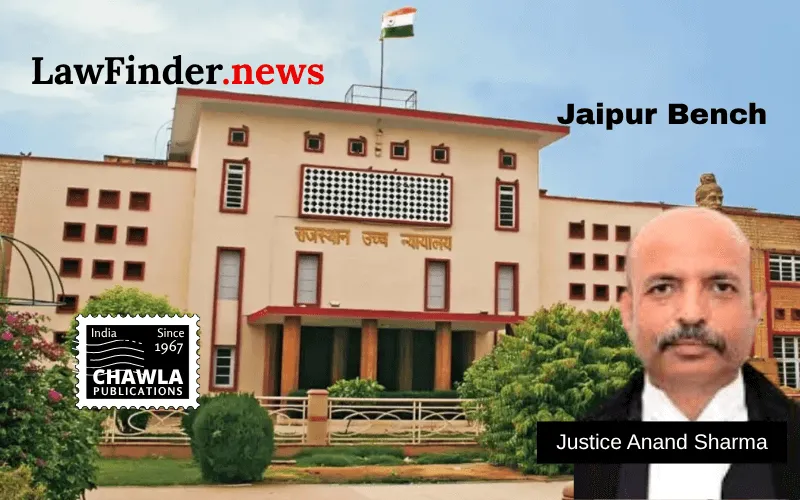
In a significant ruling, the Rajasthan High Court, Jaipur Bench, dismissed a writ petition filed by Rahul Kumar Meena, seeking compassionate appointment following the death of his father, a former constable in the Police Department. The judgment, delivered by Justice Anand Sharma, underscored the necessity for timely applications for compassionate appointments, highlighting that such appointments are meant to address immediate financial distress caused by the sudden demise of a breadwinner.
Rahul Kumar Meena, the petitioner, approached the court after his application for a compassionate appointment was rejected due to an inordinate delay. His father passed away on June 3, 2016, when Rahul was only 13 years old. The petitioner's mother initially applied for his appointment on compassionate grounds, intending to secure a position for her son upon his attaining majority. However, it wasn't until October 18, 2023, that a formal application was submitted, which was subsequently dismissed by the authorities on April 22, 2025, due to the delay.
The court reiterated that compassionate appointments are not a vested right but an exception to the general rule of public employment, intended to provide immediate financial relief to families suddenly left in financial hardship. It emphasized that prolonged delays in filing claims indicate that the immediate financial need no longer exists, thus defeating the purpose of such appointments.
Justice Anand Sharma cited several Supreme Court judgments, including the landmark cases of Sushma Gosain v. Union of India and Umesh Kumar Nagpal v. State of Haryana, which consistently held that compassionate appointments should be made promptly to fulfill their intended humanitarian purpose. The court noted that the compassionate appointment scheme aims to prevent families from falling into destitution due to the unexpected loss of their sole breadwinner.
The judgment further stressed that allowing claims for compassionate appointments after a significant delay would transform this welfare measure into a parallel mode of recruitment, violating constitutional principles of equality in public employment as enshrined in Articles 14 and 16 of the Indian Constitution.
The court dismissed the petition, noting that the family had managed to subsist for several years after the employee's death, indicating that the immediate financial crisis had been overcome. It concluded that the claim was barred by laches and undue delay, rendering it legally unsustainable.
This ruling serves as a critical reminder of the essence of compassionate appointment schemes and the necessity for timely applications to address immediate financial emergencies effectively.
Bottom Line:
Compassionate appointment is not a vested right and must be sought immediately to address the sudden financial crisis caused by the death of a breadwinner. Claims raised after undue delay are non-maintainable.
Statutory provision(s): Articles 14 and 16 of the Constitution of India.
Rahul Kumar Meena v. State of Rajasthan, (Rajasthan)(Jaipur Bench) : Law Finder Doc id # 2854238