Supreme Court Upholds High Court Order on SARFAESI Act, Highlights Need for Banking Reforms, Apex Court dismisses plea by Bhaskar International, calls for introspection into banking practices and policies.
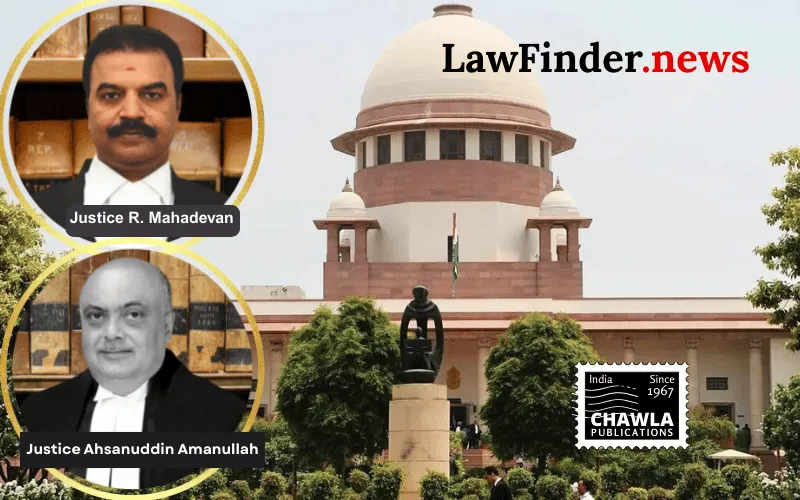
In a significant judgment, the Supreme Court of India has upheld the decision of the Punjab and Haryana High Court, dismissing the petition filed by M/s Bhaskar International Private Limited against the State Bank of India (SBI) under the Securitisation and Reconstruction of Financial Assets and Enforcement of Security Interest Act, 2002 (SARFAESI Act). The bench, comprising Justices Ahsanuddin Amanullah and R. Mahadevan, delivered the verdict on May 19, 2026, dismissing the special leave petition filed by the company.
The case revolves around a loan of Rs. 8.09 Crores availed by Bhaskar International from SBI in 2019. The company defaulted on the very first installment, leading to the account being declared a Non-Performing Asset (NPA) shortly thereafter. SBI, invoking the SARFAESI Act, sought possession of the company's properties through an application to the District Magistrate, Yamuna Nagar, which was granted in May 2024. The company contested this order in the High Court, which directed the execution of possession, prompting the appeal to the Supreme Court.
The Supreme Court, in its detailed judgment, criticized both the conduct of the borrower and the banking practices of SBI. The court noted that Bhaskar International's failure to repay even a single installment was a significant lapse, and its offer to repay the principal after six years was deemed insufficient and delayed. The judgment emphasized that the petitioner should have followed through with the statutory remedies available at the Debts Recovery Tribunal (DRT).
Simultaneously, the court expressed concern over the negligence of SBI in granting such a substantial loan without adequate assessment of the borrower's repayment capacity. The court highlighted the disparity in banking practices, where small loan seekers face stringent conditions, whereas large loans to bigger entities are sanctioned more casually. The bench urged a review of banking policies to ensure fairer and simpler procedures for loan seekers, especially those at the lowest social and financial strata.
In a bid to provide a final opportunity for relief, the court allowed Bhaskar International to seek interim relief from the DRT within two weeks, maintaining the status quo on the properties involved during this period.
This judgment not only resolves the dispute at hand but also calls for introspection and reform in banking practices, sending a strong message to financial institutions to exercise due diligence and fairness in loan sanctioning and recovery processes.
Statutory provision(s): Securitisation and Reconstruction of Financial Assets and Enforcement of Security Interest Act, 2002, Section 14
M/s Bhaskar International Private Limited v. State Bank of India, (SC) : Law Finder Doc id # 2902720