New Delhi, Jun 11 The Supreme Court on Thursday came to the rescue of a man, who was left paralysed in a freak incident nearly 19 years ago when a tree branch fell on his autorickshaw in Bengaluru, by enhancing the compensation to Rs 25 lakh.
The top court, in a significant ruling, held that in such cases, a claim seeking compensation under section 166 of the Motor Vehicles Act (MVA) cannot be filed especially against the civic body.
The provision allows road accident victims or their legal representatives to claim compensation by proving fault or negligence against the offending driver or owner.
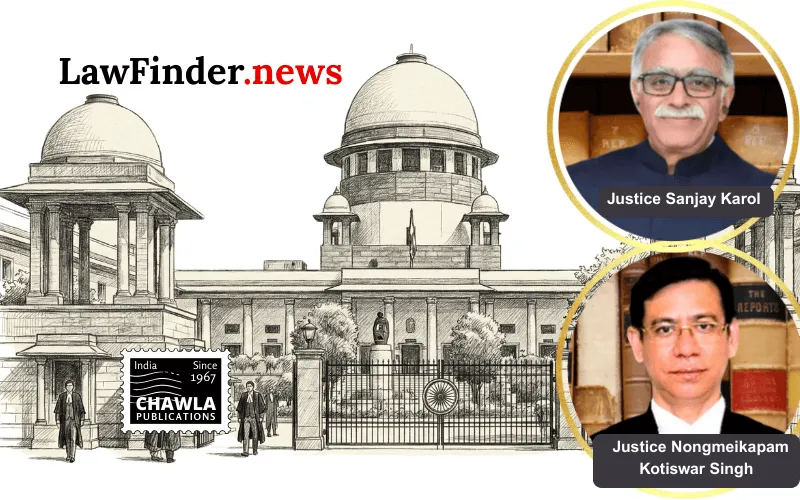
Having held that such claims were not maintainable under the MVA, a bench comprising justices Sanjay Karol and Nongmeikapam Kotiswar Singh exercised its extraordinary powers under Article 142 of the Constitution to increase the compensation from Rs 17.10 lakh to Rs 25 lakh, plus interest, for the man who has been suffering from total paraplegia since 2007.
Article 142 of the Constitution grants the Supreme Court the unique power to pass any decree or order necessary to do "complete justice" in any pending case.
"A person who has suffered such life-altering grievous injuries, being left in lurch without any money to sustain himself, does not appeal to the conscience of justice," the bench said.
It ruled that the compensation previously awarded by the High Court was "insufficient" and "technical".
The case dates back to June 23, 2007, when KK Umesh Kumar was travelling in the autorickshaw in Bengaluru. Due to heavy rain, the vehicle was stopped under an old tree near Chinnaswamy Stadium.
A large branch detached and crushed the vehicle, causing Kumar life-altering spinal injuries, leading to total paraplegia and loss of bladder control.
The verdict dealt with the issue whether appellant the Commissioner of Bruhat Bangalore Mahanagara Palike (BBMP) can be held liable under the MVA for the injuries sustained by Kumar due to the falling of a roadside tree on the vehicle which had stopped under the tree waiting for the rain to subside.
In the arduous legal journey, the compensation claim of Rs 50 lakh was rejected by the Motor Accidents Claim Tribunal (MACT) in the first round, saying that the incident a "natural calamity" or "act of God".
The Karnataka High Court also dismissed it on grounds of delay.
Later the Supreme Court remanded the matter back to the high court which, in the second round, awarded Rs 17.10 lakh as compensation.
The high court apportioned the liability and asked the BBMP, the horticulture department, and the insurer of autorickshaw to pay 25 per cent, 25 per cent and 50 per cent of the compensation respectively.
The BBMP challenged this liability in the Supreme Court, saying they could not be held responsible for a natural incident, an act of God.
Justice Karol, writing for the bench, said that while authorities cannot keep a "constant vigil" over every single tree, they do have a statutory duty to ensure trees are maintained to prevent "latent sources of physical danger".
The court noted that heavy rain in a city is a foreseeable event, and authorities must take preventive actions to maintain the health of roadside trees.
The bench admitted that the motor vehicle itself played no active role in the accident.
"The motor vehicle itself does not play an active role... it is not part of the proximate cause," the court said.
The bench directed all parties to deposit the amount into the respondent's bank account within four weeks in the same proportion as decided by the high court.