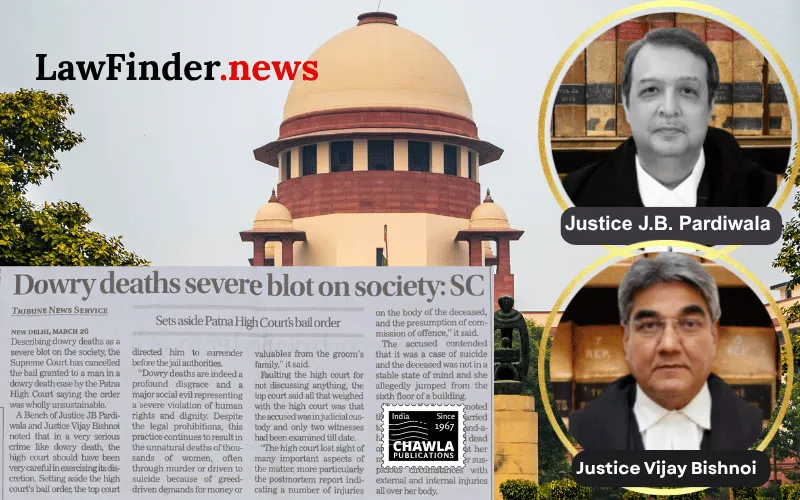
High Court's Order Found Unsustainable; Accused Husband Directed to Surrender
In a significant judgment that underscores the gravity of dowry death cases, the Supreme Court of India has canceled the bail granted to the accused husband in the case of Lal Muni Devi v. State of Bihar. The bench, comprising Justices J.B. Pardiwala and Vijay Bishnoi, expressed serious reservations regarding the High Court's order granting bail, which was deemed unsustainable due to insufficient reasoning and a lack of consideration of critical evidence.
The case stems from the tragic death of Harshika, who was found dead under suspicious circumstances at her matrimonial home, with multiple injuries noted in the post-mortem report, including a fractured skull and ruptured heart. The FIR, lodged by Lal Muni Devi, the deceased's mother, alleged dowry harassment and murder by the husband, Vikas Kumar, following demands for additional dowry items like a Bullet motorcycle and a refrigerator.
Despite the grave nature of the allegations and the evidence suggesting a dowry death, the High Court had initially granted bail, citing the accused's clean antecedents and prolonged judicial custody. However, the Supreme Court criticized the High Court's approach as mechanical and failing to account for the presumption of offense under Section 114 of the Bharatiya Sakshya Adhiniyam, 2023, which applies in dowry death cases.
The Supreme Court emphasized the need for heightened vigilance in such cases, noting that dowry deaths remain a severe social evil and courts must ensure that justice is upheld. The court observed that the High Court did not adequately consider the post-mortem findings and the presumption of offense, leading to a bail order that undermined the seriousness of the crime and public faith in the judiciary.
The Supreme Court's decision mandates the accused, Vikas Kumar, to surrender within a week, with directives for the trial to be concluded within six months. The court clarified that its observations are limited to the bail decision and should not influence the trial court's assessment of evidence.
This ruling serves as a reminder of the judiciary's crucial role in combating dowry deaths, reinforcing the need for careful scrutiny and adherence to legal provisions in such cases. The decision also highlights the importance of judicial orders in shaping societal perceptions and combating social evils like dowry-related violence.
Statutory provision(s): Section 80, Section 103(1) of Bharatiya Nyaya Sanhita, 2023; Section 114 of Bharatiya Sakshya Adhiniyam, 2023
Lal Muni Devi v. State Of Bihar, (SC) : Law Finder Doc id # 2872324