Apex Court Exercises Article 142 Powers; Grants Divorce with Rs. 50 Lakh Alimony
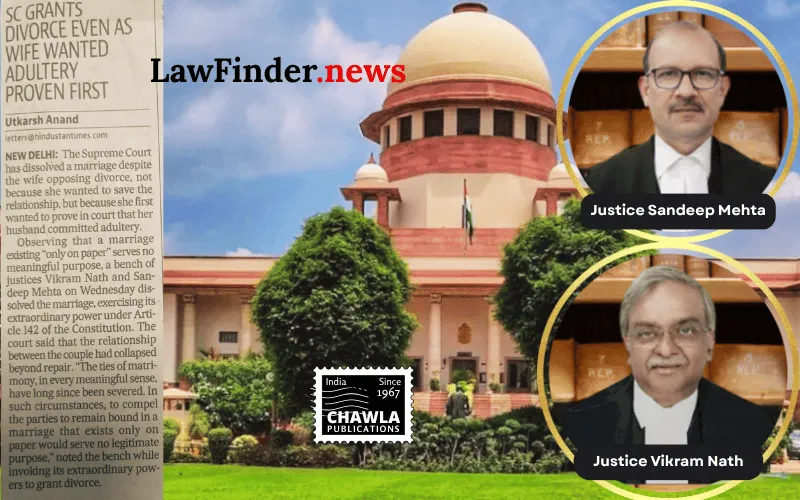
In a significant ruling, the Supreme Court of India on May 27, 2026, dissolved the marriage between Salil Dhawan and Priyanshi Ghai, citing an irretrievable breakdown of the marriage. The bench, comprising Justices Vikram Nath and Sandeep Mehta, exercised its jurisdiction under Article 142 of the Constitution to dissolve the marriage, underscoring that the couple had been living separately for over eight years with no possibility of reconciliation.
The court's decision came in response to an appeal filed by Salil Dhawan after the High Court of Allahabad upheld a Family Court's dismissal of his divorce petition. The Supreme Court acknowledged the prolonged separation and the multitude of litigations between the parties, concluding that the marriage had effectively ended in all but name.
The respondent-wife, Priyanshi Ghai, initially agreed to a mutual consent divorce, as per a settlement agreement, but later refrained from filing the second motion petition. The court noted her intention to pursue a divorce on the grounds of adultery but determined that maintaining the facade of the marriage served no legitimate purpose.
In a move to resolve all pending disputes, the Supreme Court ordered Salil Dhawan to pay a one-time permanent alimony of Rs. 50,00,000 to Priyanshi Ghai, settling all past and future claims, including those under Section 125 of the CrPC and the Army Act. The alimony is to be paid in two instalments by September 2026.
The court also directed the closure of all pending civil and criminal cases between the parties, with formal orders of closure to be issued by the respective courts. This comprehensive settlement aims to provide finality and ensure no residual claims remain.
The judgment highlights the Supreme Court's commitment to exercising its constitutional powers to provide just and equitable solutions in matrimonial disputes that have reached an impasse.
Statutory provision(s): Article 142 of the Constitution of India, Hindu Marriage Act, 1955 Sections 13(1)(i) and 13B, Section 125 of the Code of Criminal Procedure, 1973, Section 90(i) of the Army Act, 1950, Protection of Women from Domestic Violence Act, 2005.
Salil Dhawan v. Priyanshi Ghai, (SC) : Law Finder Doc id # 2907520