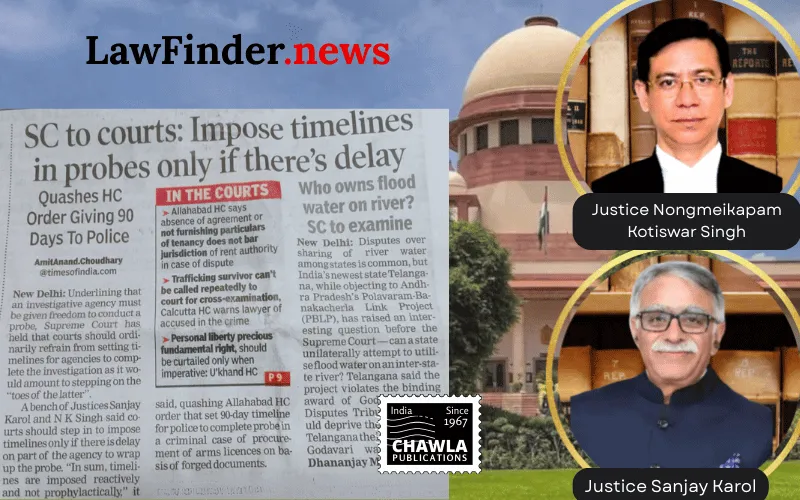
The Supreme Court emphasizes the impermissibility of granting arrest protection while dismissing quashing petitions, aligning with established legal precedents.
In a significant ruling, the Supreme Court of India has overturned the Allahabad High Court's orders which provided interim protection from arrest to the accused in a case involving forgery of arms licenses. The Supreme Court bench, comprising Justices Sanjay Karol and Nongmeikapam Kotiswar Singh, delivered the judgment on December 19, 2025, in the case of State of U.P. v. Mohd Arshad Khan, highlighting the impermissibility of such protections when dismissing quashing petitions.
The case originated from an FIR registered on May 24, 2025, at the Nai Ki Mandi Police Station, Agra. The FIR alleged that accused individuals, including Mohd Arshad Khan, had procured arms licenses using forged documents. The High Court, while refusing to quash the FIR, had directed the completion of the investigation within 90 days and provided that the accused would not be arrested until the court took cognizance of the matter. The State of Uttar Pradesh appealed against these orders.
The Supreme Court, in its judgment, reiterated the principles laid down in previous landmark rulings such as Neeharika Infrastructure Pvt. Ltd. v. State of Maharashtra (2021) and Habib Abdullah Jeelani (2017), which clearly state that such orders amount to granting anticipatory bail without adhering to the legal provisions under Section 438 of the CrPC.
The bench criticized the High Court's reliance on the Shobhit Nehra case, stating that the application of precedents requires careful consideration of the factual context, which was absent in the High Court's decision. The Supreme Court emphasized that the protection from arrest should not be granted mechanically and must be justified by specific facts of each case.
Furthermore, the Supreme Court set aside the High Court’s imposition of timelines for completing the investigation, noting that such directions should only be issued in cases of undue delay or stagnation, and must be reactive rather than prophylactic.
In conclusion, the Supreme Court's decision reinforces the necessity for High Courts to adhere strictly to established legal norms when dealing with quashing petitions and emphasizes the importance of conducting timely and efficient investigations without compromising the accused's fundamental rights under Article 21 of the Constitution.
Bottom Line:
Protection from arrest during investigation cannot be granted while dismissing quashing petitions under Section 482 of CrPC or Article 226 of the Constitution of India, as it amounts to bypassing the statutory provisions for anticipatory bail.
Statutory provision(s):
- Section 482 of the Criminal Procedure Code, 1973
- Section 438 of the Criminal Procedure Code, 1973
- Article 226 of the Constitution of India
State of U.P. v. Mohd Arshad Khan, (SC) : Law Finder Doc Id # 2824403