Judgment affirms non-consideration of salary income for creamy layer status, mandates supernumerary posts for eligible candidates.
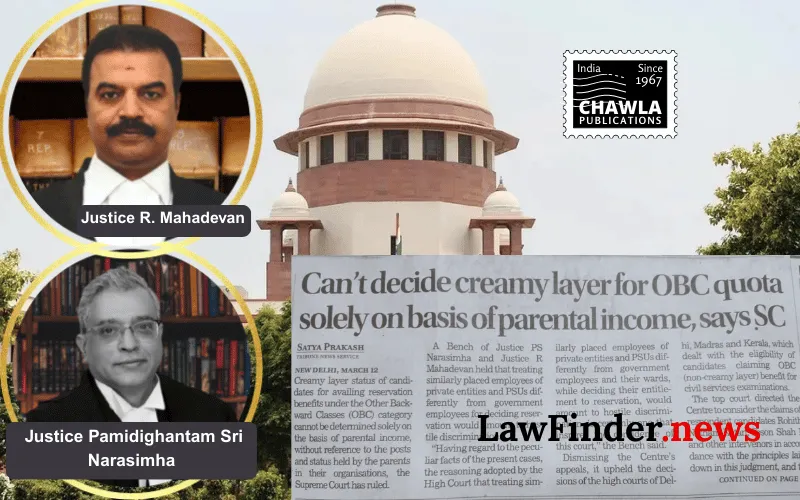
In a significant ruling, the Supreme Court of India has clarified the criteria for determining the creamy layer among Other Backward Classes (OBCs), emphasizing that income from salaries alone cannot determine exclusion from reservation benefits. The judgment, delivered by the bench of Justices Pamidighantam Sri Narasimha and R. Mahadevan, addresses appeals filed by the Union of India against various High Court decisions, including those from the Madras, Delhi, and Kerala High Courts.
The Supreme Court held that the clarificatory letter dated October 14, 2004, cannot override the substantive framework established by the Office Memorandum (OM) dated September 8, 1993. The OM specifies structured criteria for creamy layer determination, emphasizing the importance of the status and category of the parent's post over mere income from salaries. This decision aims to ensure that reservation benefits reach the truly deserving candidates among the backward classes and prevent the more advanced sections from monopolizing these benefits.
The Court further addressed the issue of discrimination between government employees and those in Public Sector Undertakings (PSUs) or private employment. It was determined that treating children of PSU or private employees differently from those of government employees based solely on income from salaries constitutes hostile discrimination. The principle of equality mandates similar treatment for similarly placed categories, and disadvantaging one segment of backward classes without rational justification is contrary to Articles 14, 15, and 16 of the Constitution.
In its directive, the Court has ordered the creation of supernumerary posts to accommodate eligible candidates fulfilling the non-creamy layer criteria as clarified in the judgment. The implementation of this directive is to be carried out within six months.
This ruling reaffirms the constitutional principle that reservation policies must be rooted in substantive equality, ensuring that the benefits reach the genuinely disadvantaged sections of society. It also underscores the need for a rational and non-discriminatory approach in the application of reservation policies across different sectors.
Bottom Line:
The clarificatory letter dated 14.10.2004 cannot override the substantive framework of the 1993 Office Memorandum (OM) which specifies exclusion criteria for OBC reservation benefits, including creamy layer determination. Income from salaries alone cannot be determinative of creamy layer status; status and category of the parent's post are essential considerations.
Statutory provision(s):
Article 14, Article 15, Article 16 of the Constitution of India; Office Memorandum dated 08.09.1993; Clarificatory Letter dated 14.10.2004
Union of India v. Rohith Nathan, (SC) : Law Finder Doc id # 2864544