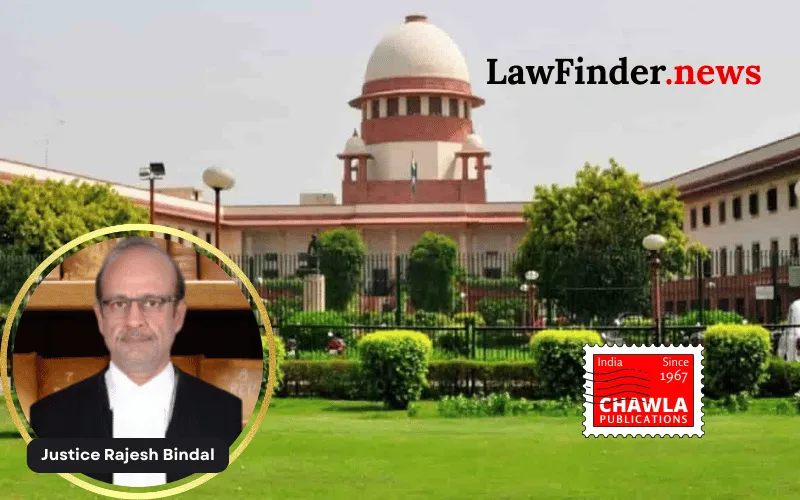
New Delhi, Feb 13 Supreme Court judge Justice Rajesh Bindal on Friday highlighted the drawbacks of technology in the contemporary judicial system, and said it should serve as a tool but not as a substitute for independent thinking and thorough reading.
Justice Bindal was speaking at the 22nd KK Luthra Memorial Moot Court Competition organised by the University of Delhi’s Campus Law Centre in association with the Nirmal Luthra Foundation, commemorating the latter’s 22nd anniversary.
This year’s competition invited teams to explore the “criminal liability arising from interference with life supporting medical technology, and the evolving legal question surrounding AI-enabled medical devices and emergency decision-making”.
Justice Bindal said the excessive reliance on technology has led to reduced attention spans among law students and a tendency to depend blindly on readily available information without critical analysis.
He underlined that every profession requires a blend of theoretical knowledge and practical exposure, and in the legal field, practical learning often comes much later.
“Moot court competitions bridge this gap by equipping students with practical skills and preparing them for future professional challenges, he said.
The rapid evolution of technology, particularly in recent years with the advent of artificial intelligence, has taken technological development in an entirely new direction, Justice Bindal said.
He pointed out that in comparison to other countries, Indian courts have adapted to technological advancements more effectively.
“Indian courts now routinely use live streaming, virtual courts, digital courts, e-library and e-filing systems, making the justice delivery system more accessible and convenient for both litigators and citizens,” he said.
“Through virtual courts, the judiciary has effectively reached the doorstep of the public, while e-courts have become the functional office of every lawyer,” the judge added.
Advocate Samarth Krishan Luthra delivered the concluding remarks and vote of thanks.