Court says motive was unproved, alleged confession before police was inadmissible, brick recovery was not linked to accused, and call records alone could not establish guilt
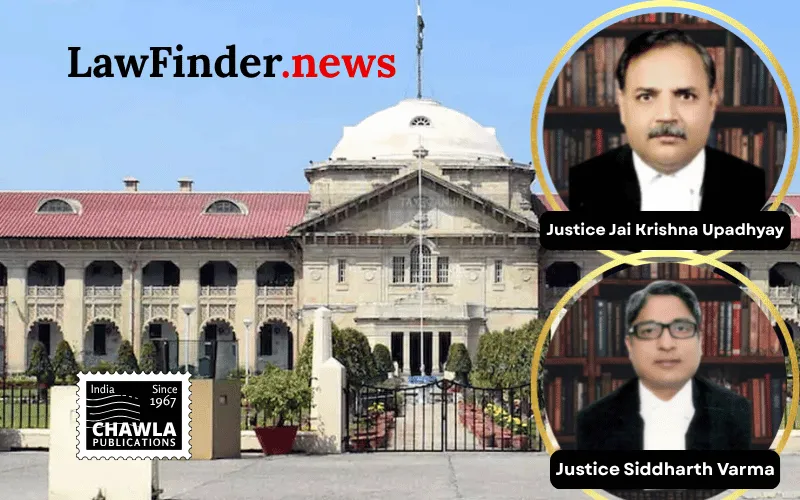
The Allahabad High Court has set aside the conviction of Shahrukh and Hasnera alias Shabana in a murder case from Firozabad, holding that the prosecution failed to prove a complete chain of circumstantial evidence. A division bench of Justice Siddhartha Varma and Justice Jai Krishna Upadhyay allowed the criminal appeal and jail appeal, acquitting both accused and directing their release forthwith if not wanted in any other case.
The case arose from the death of Naeem, whose body was found near Pawan brick kiln on Malkhanpur Road in Shikohabad. According to the prosecution, Naeem was allegedly murdered by his wife Hasnera alias Shabana and her alleged lover Shahrukh, with the motive being an illicit relationship. The trial court had convicted both accused under Sections 302 and 120-B of the Indian Penal Code and sentenced them to life imprisonment with a fine of Rs. 30,000 each.
Before the High Court, the defence argued that the case rested entirely on circumstantial evidence and that the prosecution had failed to establish the alleged motive, the supposed confession, and the recovery of the murder weapon. The State, however, maintained that call detail records, witness statements, and the accused persons’ alleged confession were sufficient to sustain the conviction.
The High Court examined the evidence in detail and reiterated the settled legal principles governing convictions based on circumstantial evidence. Relying on Supreme Court precedents including Sharad Birdhichand Sarda v. State of Maharashtra, the bench noted that each circumstance must be fully proved, must be consistent only with guilt, and must form a complete chain excluding every hypothesis of innocence.
On the issue of motive, the court found that the prosecution had failed to produce reliable evidence proving an illicit relationship between Shahrukh and Hasnera. The informant and her son had only expressed suspicion and had no personal knowledge of such a relationship. No independent witness or prior complaint supported the allegation. The bench held that once motive failed, the first link in the chain of circumstances broke.
The court also rejected the prosecution’s reliance on the alleged confession made by the accused before the investigating officer. It pointed out that a confession made while in police custody is inadmissible under Section 26 of the Indian Evidence Act, 1872, unless made in the immediate presence of a Magistrate.
Similarly, the court held that the recovery of a brick from the place of occurrence could not be treated as a recovery at the instance of the accused, and therefore did not strengthen the prosecution case. The bench further observed that call detail records may at best be corroborative, but cannot by themselves prove that the accused and the deceased were together at the scene of the crime. The court cautioned against treating CDRs as exclusive proof of guilt.
Finding that several crucial links were missing, the High Court concluded that the prosecution had not proved the case beyond reasonable doubt. It held that it would not be safe to sustain the conviction and sentence. As a result, both appeals were allowed, the conviction was set aside, and Shahrukh and Hasnera alias Shabana were acquitted by granting them the benefit of doubt.
Bottom Line :
Circumstantial evidence - Murder case - Conviction cannot be sustained where motive of illicit relationship is not proved, alleged confession before Investigating Officer is inadmissible, recovery of brick is from place of occurrence and not at instance of accused, and CDR alone cannot be treated as evidence of accused and deceased being together - Benefit of doubt granted.
Statutory provision(s): Sections 302, 120-B, 313 of the Indian Penal Code, 1860, Section 26 of the Indian Evidence Act, 1872, Section 302 of the Code of Criminal Procedure, 1973
Shahrukh v. State of U.P., (Allahabad)(DB) : Law Finder Doc id # 2983334