Court rules that High Court's writ jurisdiction cannot be invoked without exhausting remedies under Bharatiya Nagarik Suraksha Sanhita, 2023, and CrPC.
In a significant ruling, the Allahabad High Court dismissed a writ petition filed by Amit Kumar Srivastava, a press reporter, seeking the registration of a First Information Report (FIR) against certain individuals. The petitioner alleged police inaction following an attack on him and sought the Court's intervention to command the police to register an FIR. However, the Court emphasized the need to exhaust statutory remedies before invoking its writ jurisdiction under Article 226 of the Constitution of India.
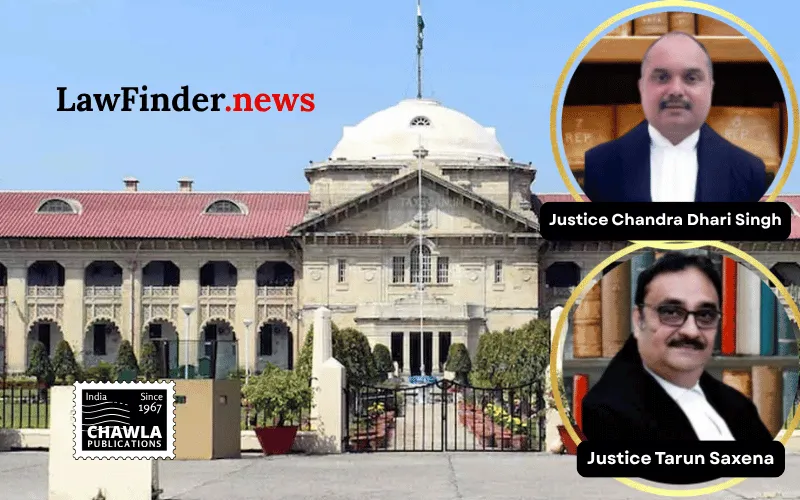
The Division Bench, comprising Justices Mr. Chandra Dhari Singh and Tarun Saxena, underscored the discretionary nature of writ jurisdiction and the necessity of exhausting alternative remedies, as provided under the Bharatiya Nagarik Suraksha Sanhita (BNSS), 2023, and the Code of Criminal Procedure (CrPC), 1973. The Court highlighted that the petitioner should first approach the Magistrate under Section 175(3) of the BNSS (equivalent to Section 156(3) CrPC), which empowers the Magistrate to direct FIR registration and monitor investigations.
The petitioner, a reporter for News18, claimed that on August 1, 2025, he was attacked by unknown assailants allegedly linked to the mafia associated with Atiq Ahmad. Despite filing a complaint with the local police, no FIR was registered. The Court noted that the police, upon investigation, found the allegations false and fabricated. The State countered the petition, arguing that the petitioner's claims were baseless and an attempt to misuse the legal process.
Reaffirming the principles set forth in the Supreme Court's decision in Sakiri Vasu v. State of Uttar Pradesh, the High Court reiterated that grievances regarding non-registration of FIRs should first be addressed through the statutory hierarchy, starting with the police and, if necessary, proceeding to the Magistrate. The Court expressed concern over the growing trend of bypassing these remedies and approaching the High Court directly, which burdens the judiciary and undermines legislative intent.
The judgment serves as a reminder of the procedural safeguards and structured legal framework in place for addressing grievances related to FIR registration. By dismissing the petition, the Court reinforced the importance of adhering to established legal processes and the primary role of statutory remedies in the criminal justice system.
Bottom Line :
The High Court under Article 226 of the Constitution cannot be approached as the first resort for compelling the registration of an FIR when statutory remedies under the Bharatiya Nagarik Suraksha Sanhita (BNSS), 2023, or Code of Criminal Procedure, 1973, remain unexhausted.
Statutory provision(s): Article 226 of the Constitution of India, Sections 173, 175(3) of the Bharatiya Nagarik Suraksha Sanhita, 2023, Sections 154(3), 156(3) of the Code of Criminal Procedure, 1973.
Amit Kumar Srivastava v. State of U.P., (Allahabad)(DB) : Law Finder Doc id # 2963019