Court finds petitioner acted as proxy litigant with oblique motives, filed three previous cases on same subject matter without disclosure, and made false statements on affidavit; landmark judgment emphasizes PIL cannot be tool for personal vendetta or business rivalry
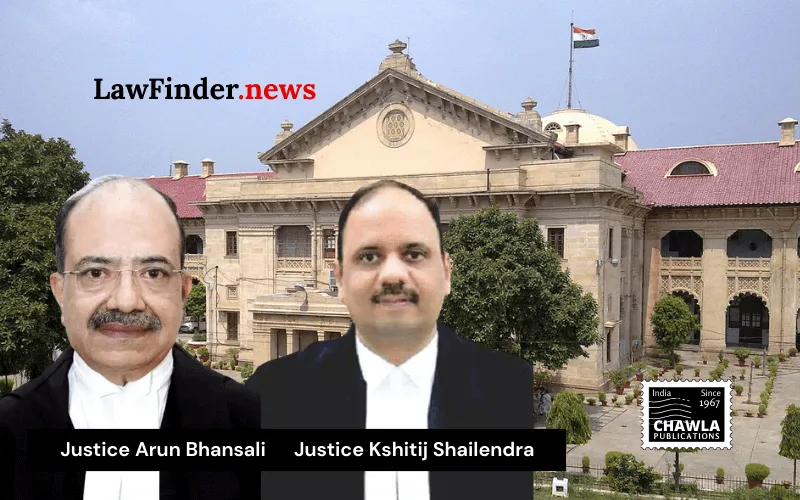
In a significant judgment upholding the sanctity of Public Interest Litigation (PIL), the Allahabad High Court, comprising Chief Justice Arun Bhansali and Justice Kshitij Shailendra, dismissed a PIL filed by journalist Shailesh Singh seeking to quash a tender process dating back to 2015 and directed him to pay exemplary costs of Rs. 2,00,000.
The Court found that the petitioner had grossly misused the PIL process by suppressing his previous litigation history while attempting to challenge a public-private partnership (PPP) concession for a municipal slaughterhouse at Mohanpur Thiriya, Bareilly, that was awarded to Marya Frozen Agro Food Products Pvt. Ltd. in 2015.
Background of the Case
The petitioner, identifying himself as an investigative journalist and editor of 'Rashtriya Samasya,' filed the present PIL on July 21, 2026, challenging the tender award made over a decade ago. He sought quashing of the award letter dated December 11, 2015, on grounds of alleged fraud, collusion, and violation of constitutional Articles 14, 21, and 300-A. The petitioner further sought directions for a fresh transparent re-tender with mandatory verification against Ministry of Corporate Affairs records.
Concealment of Material Facts
The High Court's investigation revealed that the petitioner had previously filed three cases relating to the same respondent company without disclosing this history:
- 1. PIL No. 1869 of 2024 – Dismissed as withdrawn on September 21, 2024, for non-compliance with mandatory provisions of Allahabad High Court Rules, Chapter XXII Rule 1(3-A)
- 2. PIL No. 2186 of 2024 – Disposed on November 18, 2024, with the Court declining to examine issues and permitting the petitioner to approach the National Green Tribunal (NGT)
- 3. Original Applications before NGT – The petitioner filed Original Application No. 1399 of 2024 (dismissed as withdrawn) and Original Application No. 17 of 2025 (pending), both concerning the same company
Additionally, the petitioner had attempted to get himself impleaded in Writ Petition No. 6643 of 2024 filed by the respondent company before the Lucknow Bench, a request that was declined.
False Declarations on Affidavit
The Court noted that the opening paragraph of the petition falsely declared: "This is the first petition in respect of the present cause of action or for the reliefs sought therein and that the petitioner has not filed any other PIL/writ petition against the same cause of action." The petitioner had sworn on affidavit that "nothing material has been concealed and that no part of this affidavit is false," rendering these statements patently false.
Court's Finding on Abuse of Process
The High Court observed that the petitioner's pattern of repeated litigation over eleven years, following the 2015 tender award, demonstrated a clear pattern of harassment. The Court found that the petitioner was acting as a proxy litigant at the instance of competitors of respondent No. 4, driven by oblique motives rather than genuine public interest. The fact that the petitioner "could not succeed before this Court in three attempts" and that the first NGT application was "dismissed as withdrawn" further substantiated this conclusion.
Legal Principles Applied
The Court relied on several landmark Supreme Court judgments to establish principles governing PIL jurisdiction:
- - Janata Dal v. H.S. Chowdhary (1992): Only persons acting bonafide with genuine interest can maintain PIL; vexatious petitions deserve rejection at threshold
- - Dr. B. Singh v. Union of India (2004): Courts should filter out frivolous petitions with cost; petitions styled as PIL but serving as camouflage for personal disputes must be dismissed
- - Buddhi Kota Subbarai v. K. Parasaran (1996): No litigant has unlimited right to court time and public money
- - Prestige Lights Ltd. v. State Bank of India (2007): Suppression of facts or misleading the Court warrants dismissal without adjudication
- - K.D. Sharma v. Steel Authority of India Ltd. (2008): No litigant can play "hide and seek" with courts or adopt "pick and choose" strategy
Imposition of Exemplary Costs
The Court imposed heavy costs of Rs. 2,00,000 to serve as a deterrent to unscrupulous litigants attempting to abuse PIL jurisdiction under guise of public interest. The petitioner was directed to deposit this amount with the Legal Services Committee within one month. If payment is not made, the Collector, Bareilly, will initiate recovery proceedings to recover the amount as arrears of land revenue.
Significance of the Judgment
This judgment sets an important precedent emphasizing that:
- 1. PIL is not a weapon for personal vendetta, business rivalry, or political motive
- 2. Suppression of material facts regarding previous litigation on the same subject matter constitutes abuse of court's jurisdiction
- 3. Courts must rigorously scrutinize PIL petitions to filter frivolous and vexatious cases
- 4. Full and truthful disclosure is mandatory; litigants cannot adopt selective pleading
- 5. Exemplary costs are appropriate to deter misuse of judicial process
The Allahabad High Court's stern approach reflects judicial concern that unchecked abuse of PIL can dilute its utility as a powerful tool for protecting public rights and environmental protection. The judgment underscores that courts must balance easy access to justice against the need to prevent frivolous litigation that wastes precious judicial time and resources.
Bottom Line:
Public Interest Litigation (PIL) - Abuse of process of law - Filing of repetitive PILs with suppression of previous litigation history and personal motives - PIL dismissed with heavy cost of Rs. 2,00,000/- for gross misuse of judicial process.
STATUTORY PROVISION(S)
Constitution of India - Articles 14, 21, 300-A; Water (Prevention and Control of Pollution) Act, 1974; National Green Tribunal Act, 2010 - Section 29; Allahabad High Court Rules - Chapter XXII Rule 1(3-A)
Shailesh Singh v. State of Uttar Pradesh, (Allahabad)(DB) : Law Finder Doc id 2970315