Court rules that Rule 23 of U.P. Police Officers (Punishment & Appeal) Rules, 1991 does not bar applying Limitation Act’s Section 5 for delay condonation; directs revising authority to decide revision on merits despite delay
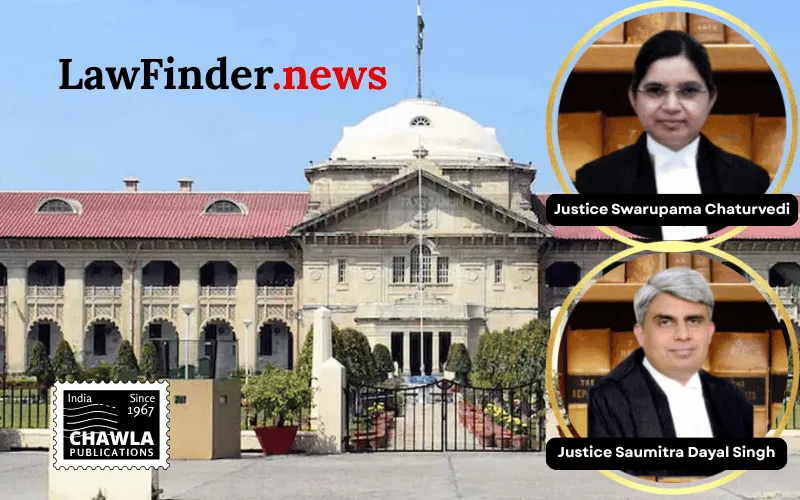
In a significant judgment delivered on September 1, 2026, the Allahabad High Court (Division Bench comprising Justices Saumitra Dayal Singh and Swarupama Chaturvedi) clarified the applicability of the Limitation Act, 1963 in disciplinary revision proceedings under the U.P. Police Officers of the Subordinate Ranks (Punishment and Appeal) Rules, 1991 (“Rules”). The court held that in absence of any express bar or restriction in Rule 23 of the Rules regarding condoning delay, the Revising Authority possesses the power to condone delay in filing a revision petition by applying Section 5 read with Section 29(2) of the Limitation Act, 1963.
The case arose from disciplinary proceedings initiated against Vijay Kumar, a police constable who was dismissed from service for unauthorized absence. After dismissal and subsequent appeal rejection, he filed a revision before the Inspector General of Police, Meerut, beyond the three months’ limitation period prescribed under Rule 23(1) of the Rules. The revision was dismissed as time-barred. Vijay Kumar challenged this dismissal through a writ petition which was dismissed by a single judge of the High Court. The present intra-court appeal was filed against that order.
The Court noted that Rule 23(1) prescribes a three-month time limit for filing revision applications but does not expressly exclude or restrict the applicability of the Limitation Act's provisions relating to condonation of delay. The Court emphasized the legislative intent behind Rule 23 which allows the Revising Authority to suo motu call for records after the expiry of the three-month period, indicating that the limitation period is not absolute or rigid. It further observed that the Limitation Act’s Section 29(2) allows the application of Sections 4 to 24 of the Act unless expressly excluded by the special law, and no such exclusion was found in the Rules.
Referring to the Supreme Court decision in Superintending Engineer/Dehar Power House Circle Bhakra Beas Management Board vs. Excise and Taxation Officer (2020) 17 SCC 692, the High Court reiterated that delay condonation powers under Section 5 apply to special or local laws unless clearly excluded. The Court held that the single judge erred in dismissing the revision as time-barred without considering the power to condone delay.
Given that nearly 20 years had passed since the revision was filed, and in absence of any special circumstances cited by the State to oppose condonation, the Division Bench condoned the delay and set aside the impugned orders. The Court directed the Revising Authority to hear and decide the revision on merits treating the delay as condoned and to do so preferably within three months from the date of the order.
This judgment clarifies that disciplinary revisional proceedings under the U.P. Police Officers Rules are not immune from the provisions of the Limitation Act regarding delay condonation. It strengthens the procedural safeguards available to subordinate police officers by ensuring that delay in filing revisions can be condoned on sufficient cause, thereby allowing substantive justice to prevail over procedural technicalities.
Bottom Line:
In absence of a specific bar or restriction under Rule 23 of the U.P. Police Officers of the Subordinate Ranks (Punishment and Appeal) Rules, 1991, the Revising Authority has the power to condone delay in filing a revision under Section 5 read with Section 29(2) of the Limitation Act, 1963.
Statutory provision(s): Rule 23 of the U.P. Police Officers of the Subordinate Ranks (Punishment and Appeal) Rules, 1991, Section 5 of the Limitation Act, 1963, Section 29(2) of the Limitation Act, 1963
Vijay Kumar v. State of U.P., (Allahabad)(DB) : Law Finder Doc Id # 2975907