Court says sentence can be suspended in fixed-term cases after substantial custody, but conviction cannot be stayed merely to avoid election disqualification under the Representation of the People Act
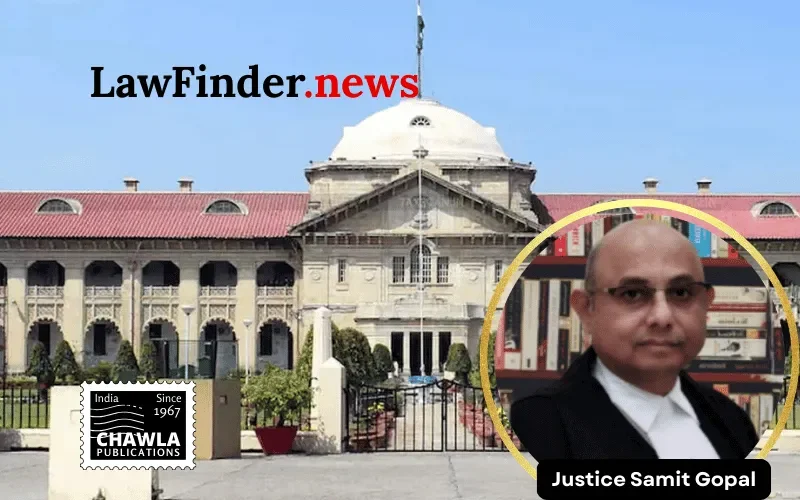
The Allahabad High Court has granted bail to Samajwadi Party leader Mohd. Azam Khan and his son Mohd. Abdullah Azam Khan by suspending their sentences in a criminal revision arising out of a forged PAN card case, while refusing to stay their convictions ahead of the forthcoming Uttar Pradesh Assembly elections.
Justice Samit Gopal passed the order on 29 October 2026 in connected Criminal Revision Nos. 3893 of 2026 and 3685 of 2026. The revisions challenge the trial court judgment dated 17 November 2025 and subsequent appellate orders dated 20 April 2026 and 23 May 2026, by which both were convicted and their sentences were enhanced.
The prosecution case stems from an FIR lodged on 6 December 2019 by Akash Saxena in Rampur. According to the allegations, Abdullah Azam Khan used a forged second PAN card carrying an altered date of birth to overcome the minimum age requirement for contesting the 2017 Uttar Pradesh Legislative Assembly election from the Swar constituency. The prosecution alleged that the forged document was created and used in conspiracy with his father, Azam Khan, and was relied upon in nomination papers and related bank account details.
Both revisionists were convicted under Sections 120B, 420, 467, 468 and 471 of the Indian Penal Code. The trial court had initially awarded concurrent sentences, but the appellate court later enhanced them. For Azam Khan, the maximum sentence was increased to 10 years’ rigorous imprisonment under Section 467 IPC. For Abdullah Azam Khan, the maximum sentence stood at 7 years’ rigorous imprisonment under the same provision.
While seeking relief, counsel for the revisionists argued that no offence was made out, that no one had been deceived, and that the case involved double jeopardy because Abdullah Azam Khan had already been acquitted in another case concerning use of the same document for obtaining a passport. They also stressed the period already spent in custody: over 4 years in the case of Azam Khan and over 3 years and 6 months in the case of Abdullah Azam Khan. The defence further urged the court to stay the conviction, arguing that otherwise both would face disqualification from contesting the upcoming Assembly elections.
Opposing the plea, the State and private respondents argued that the forged PAN card was deliberately created to alter Abdullah Azam Khan’s date of birth and secure electoral eligibility. They contended that the evidence on record showed active involvement of both accused in filing sworn affidavits and nomination documents. On the issue of double jeopardy, the respondents submitted that the argument could only be examined at the final hearing of the revisions and not at the interim stage.
The High Court accepted the plea for suspension of sentence, noting that both cases involved fixed-term sentences and that the revisionists had already undergone substantial incarceration. The court observed that Azam Khan had served more than 4 years and Abdullah Azam Khan more than 3 and a half years, and that the revisions were still pending final adjudication. In these circumstances, the court held that the case was fit for enlarging both revisionists on bail. It directed that each furnish a personal bond with two sureties and deposit half of the fine imposed by the appellate court forthwith.
However, the court firmly rejected the request to stay the conviction. Relying on Supreme Court precedents including Navjot Singh Sidhu, Ravikant S. Patil, K.C. Sareen, Afjal Ansari and Public Interest Foundation, the High Court held that stay of conviction is an exception, not the rule, and can be granted only in rare and exceptional cases. It said that mere statutory disqualification under Section 8 of the Representation of the People Act, 1951, or adverse political consequences, does not automatically entitle a convict to suspension of conviction.
Justice Gopal emphasized that in deciding such a request, the court must weigh criminal antecedents, the gravity of the offence and the wider social impact. The judgment noted that, on their own showing, Azam Khan was involved in 92 criminal cases and Abdullah Azam Khan in 46 cases, with prior convictions also recorded against both. Given these antecedents and the nature of the allegations—use of forged documents to obtain electoral eligibility—the court found no justifiable reason to stay the convictions.
The High Court also clarified that the double jeopardy argument would be considered at the final hearing of the revisions and did not require determination at the stage of deciding applications for suspension of sentence and stay of conviction.
The court admitted both criminal revisions, expedited their hearing and directed that they be listed in the third week of January 2027 for final hearing.
Bottom Line:
Suspension of sentence pending criminal revision may be granted in a case of fixed term sentence considering period of incarceration already undergone; however, stay of conviction is not to be granted as a matter of course merely to avoid disqualification under the Representation of the People Act, 1951, and can be refused having regard to gravity of offence, criminal antecedents and wider public interest.
Statutory provision(s): Sections 120B, 420, 467, 468, 471 of the Indian Penal Code, 1860; Section 389 of the Code of Criminal Procedure, 1973; Section 8 of the Representation of the People Act, 1951; Article 136 of the Constitution of India
Mohd Azam Khan v. State of U.P., (Allahabad) : Law Finder Doc id # 3006471