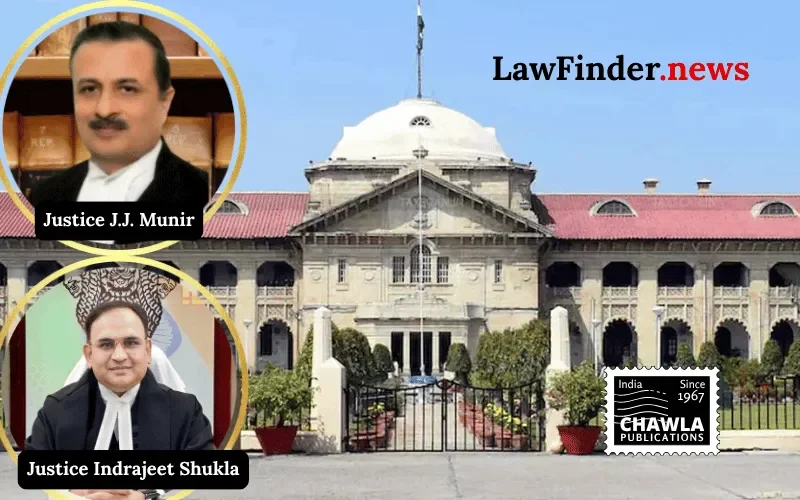
Court holds persistent pressure to live separately from elderly widowed mother and prolonged desertion as mental cruelty under Hindu Marriage Act, 1955; alternative relief of restitution of conjugal rights and divorce permissible in one petition
In a significant judgment dated September 21, 2026, the Allahabad High Court (Division Bench comprising Justices J.J. Munir and Indrajeet Shukla) allowed an appeal filed by Harsh Deepankar Tiwari, dissolving his marriage with Smt. Heeresh Tiwari on the ground of mental cruelty under Section 13(1)(ia) of the Hindu Marriage Act, 1955. The Court reversed the Family Court's ex parte dismissal of the matrimonial petition, which sought restitution of conjugal rights under Section 9 and, alternatively, divorce under Section 13 of the Act.
The appellant-husband's case was that the respondent-wife persistently pressured him, the sole son living with his 68-year-old widowed mother, to abandon his mother and live separately, thereby subjecting him to mental cruelty. The respondent also allegedly insulted and misbehaved with the appellant's mother and left the matrimonial home in 2012, remaining absent for nearly three years, depriving the appellant of cohabitation. The appellant was further threatened with false criminal implications by the respondent, sowing seeds of fear that affected his mental peace and employment.
Despite the respondent's non-appearance and failure to file a written statement, the Family Court dismissed the petition, doubting allegations of the wife taking away jewellery and cash. The High Court found this approach erroneous, observing that matrimonial cases cannot be tried as criminal theft cases and that uncontroverted pleadings and unimpeached evidence in ex parte proceedings carry full evidentiary value. The Court relied on the oral testimony of the appellant and two witnesses, including the respondent's own mother and brother, whose statements remained unchallenged due to the respondent's absence.
The Court extensively reviewed precedents from the Supreme Court and other High Courts, affirming that mental cruelty encompasses conduct causing reasonable apprehension of harm or making life together intolerable. Specifically, persistent pressure to separate from elderly parents and prolonged desertion constitute mental cruelty. The Court held that the alternative reliefs of restitution of conjugal rights and divorce can be claimed in one petition, though only one relief can be granted.
Rejecting the Family Court's refusal, the High Court granted the decree of divorce, declaring the petition for restitution of conjugal rights otiose. The Court noted the absence of any permanent alimony application from the respondent and left the door open for such claims post-divorce.
This judgment reinforces the principle that cruelty in matrimonial disputes is assessed on the cumulative effect of conduct and the impact on the aggrieved spouse's mental well-being. It also clarifies procedural aspects in ex parte matrimonial proceedings, emphasizing that courts must independently assess the evidence and cannot mechanically dismiss unchallenged claims.
Bottom Line:
Hindu Marriage Act, 1955 - Mental cruelty - Persistent pressure by wife upon husband, who was sole son, to abandon his aged widowed mother and live separately, coupled with threats/apprehension of false criminal implication and long continuous separation - Held, amounts to mental cruelty - In ex parte matrimonial proceedings, uncontroverted pleadings supported by unimpeached affidavit/oral evidence can be relied upon, though Court must still independently assess whether legal case is made out - Alternative reliefs of restitution of conjugal rights and divorce can be claimed in one petition, though only one can ultimately be granted.
Statutory provision(s):
Hindu Marriage Act, 1955 Sections 9, 13(1)(ia), 25; Family Courts Act, 1984 Sections 14, 16, 19; Civil Procedure Code, 1908 Orders VIII Rule 10, IX Rule 6(a), XIX, XX Rule 4(2)
Harsh Deepankar Tiwari v. Smt. Heeresh Tiwari, (Allahabad)(DB) : Law Finder Doc Id # 2997183



