Court emphasizes merit-based appointments, need assessment, gender representation, and accountability while distinguishing its approach from Punjab-Haryana precedent
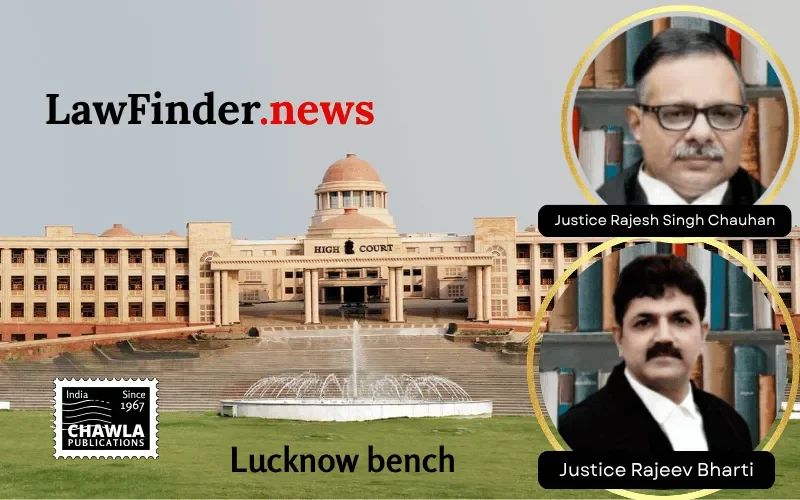
In a significant judgment delivered on October 5, 2026, the Allahabad High Court, Lucknow Bench, addressed multiple public interest litigations and writ petitions challenging the appointment process of State Law Officers in Uttar Pradesh. The petitions primarily questioned the transparency, fairness, and compliance with the Supreme Court's landmark judgment in State of Punjab v. Brijeshwar Singh Chahal (2016) regarding the appointment of government advocates.
The Court heard petitions filed by Mahendra Singh Pawar, Manendra Nath Rai, Rama Shankar Tiwari alias Rama Shankar, and others, raising concerns about arbitrary appointments, lack of objective selection criteria, inadequate representation of women, absence of criminal antecedents checks, and the unchecked private practice of State Law Officers against the State's interest.
Key Issues and Findings:
The Court examined whether the Supreme Court's directions in Brijeshwar Singh Chahal, which were based on a Comptroller and Auditor General (CAG) report highlighting irregularities in Punjab and Haryana, apply identically to Uttar Pradesh. It found that the foundational factual matrix in UP differs, notably because UP has a Legal Remembrancer's Manual ("LR Manual") governing appointments, unlike Punjab and Haryana. Hence, the Court held that the Chahal judgment's ratio cannot be mechanically imposed on UP without considering local facts.
However, the Court underscored that irrespective of procedural differences, appointments must be merit-based, transparent, and free from extraneous considerations. It stressed that the State must demonstrate that a genuine search for meritorious candidates was undertaken.
Assessment of Need and Workload:
The Court identified a glaring absence of any realistic assessment of the number of State Law Officers required, noting that appointments appear to have been made arbitrarily or for non-legal considerations, leading to an excessive number of appointees and financial strain on the public exchequer. The Court mandated that future appointments must be preceded by a proper needs assessment to ensure efficient and judicious use of public funds.
Criminal Antecedents and Integrity:
A critical concern raised was the absence of any provision in the LR Manual disqualifying individuals facing serious criminal cases from appointment or continuation as State Law Officers. The Court emphasized that legal officers must maintain the highest standards of integrity and public confidence. It directed that any FIR or criminal case registered against a State Law Officer must be promptly communicated to the Advocate General for necessary action.
Gender Representation:
Though an intervenor's challenge to the LR Manual's adequacy in ensuring women's representation was found not maintainable in the present proceedings, the Court urged the government to make sincere efforts to ensure adequate representation of women advocates, referencing the Supreme Court's principle of 30% representation as a benchmark.
Private Practice Restrictions:
The Court addressed concerns about State Law Officers engaging in private practice, especially litigating against the State. It clarified that such officers must obtain prior No Objection Certificates (NOCs) from competent authorities before appearing against the State and attach these NOCs with their vakalatnama. Violations would entail disciplinary consequences. However, these restrictions do not apply to Brief Holders, subject to specified conditions.
Appointment of Chief Standing Counsel:
The Court expressed concern over the appointment of six Chief Standing Counsel in the High Court, whereas the LR Manual contemplates only one each for the Allahabad and Lucknow Benches. It directed that any such appointments beyond the prescribed number must be justified by reasonable and objective workload assessments.
Supervision and Accountability Mechanisms:
While the LR Manual provides a supervisory framework including annual returns on cases handled, the Court directed that such reporting should extend beyond criminal cases to all categories of matters to facilitate proper workload assessment and accountability. It declined to create a separate grievance redressal committee, citing risks of frivolous complaints, but emphasized strengthening existing mechanisms.
Guidelines Issued for Future Appointments:
The Court laid down detailed guidelines for the State Government, including:
- 1. Conducting a need-based, realistic assessment of the number of State Law Officers required.
- 2. Prescribing clear, objective, transparent eligibility and selection criteria based on professional experience, competence, integrity, behavior, and suitability.
- 3. Ensuring no appointment of persons with criminal antecedents or undesirable conduct.
- 4. Extending reporting requirements to all case categories handled by State Law Officers.
- 5. Transparency of the entire selection and appointment process, including publication of criteria and procedures to the extent permissible.
- 6. Ensuring adequate representation of women advocates, subject to availability.
- 7. Immediate reporting of FIRs/criminal cases against State Law Officers to the Advocate General.
- 8. Regulating private practice against the State by requiring prior NOC attached to vakalatnama.
- 9. Examining whether State Law Officers may contest elections to Bar Associations or Bar Councils while in office, and regulating accordingly.
State's Position and Court's Observations:
The State of Uttar Pradesh argued that the Chahal judgment is factually distinguishable and not directly applicable, as UP has an established LR Manual and a hybrid remuneration system that links fees to appearances rather than a fixed salary. It also highlighted the absence of evidence showing lack of merit or competence among appointed advocates. The Court accepted these distinctions but insisted on adherence to principles of merit, transparency, and accountability.
The Court also noted the State's formation of a Selection Committee chaired by the Advocate General to scrutinize appointments, marking a positive step.
Impact and Significance:
This judgment provides a nuanced approach balancing respect for the State's administrative domain with the judiciary's role in ensuring public accountability and integrity in appointments. It refrains from blanket application of Supreme Court precedents where factual contexts differ but mandates adherence to fundamental principles of fairness, transparency, merit, and public interest.
The guidelines are expected to bring systemic reform in the appointment and regulation of State Law Officers in Uttar Pradesh, enhancing the quality and credibility of government litigation and safeguarding public resources.
Bottom Line:
Appointment of State Law Officers in Uttar Pradesh - Directions issued to ensure need-based assessment, objective and transparent selection, scrutiny of criminal antecedents, broader performance reporting, adequate representation of women and regulation of private appearances against State interest - Supreme Court decision in State of Punjab v. Brijeshwar Singh Chahal held not mechanically applicable to U.P. in absence of same foundational facts, though merit, fairness and transparency remain mandatory.
Statutory provision(s):
Articles 14, 15, 16 of the Constitution of India; Legal Remembrancer's Manual (Uttar Pradesh).
Mahendra Singh Pawar v. State of U.P., (All)(DB)(Lucknow) : Law Finder Doc Id # 2993235