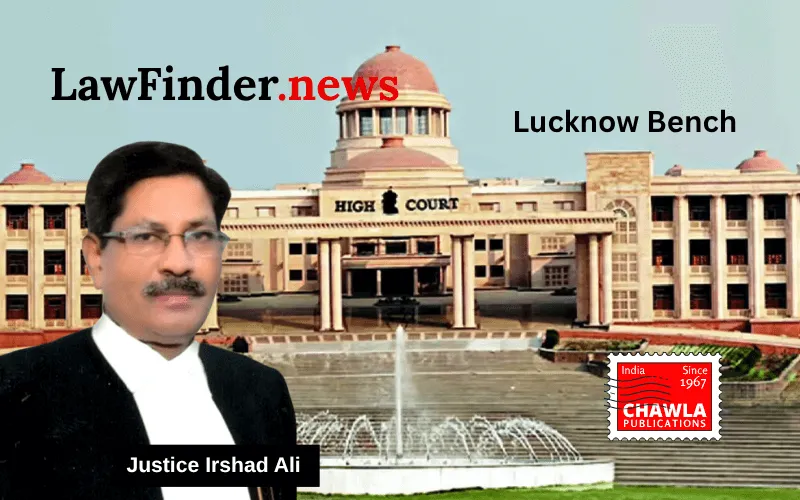
Court says authorities cannot deny relief merely because application was filed after five years when claimant was a minor and family hardship may have continued.
The Allahabad High Court’s Lucknow Bench has set aside the rejection of a compassionate appointment claim and directed the State Government to reconsider the matter afresh within two months, after examining whether the family of the deceased employee was still facing financial distress.
Justice Irshad Ali delivered the judgment in a writ petition filed by Jitendra Srivastava, who sought appointment on compassionate grounds under the U.P. Recruitment of Dependents of Government Servants Dying-in-Harness Rules, 1974.
According to the case, the petitioner’s father, Narendra Kumar Srivastava, was serving as a Patr Vahak under the Zila Basic Shiksha Adhikari, Unnao, when he died in service on 19 July 1994. The petitioner was only about 10 years old at the time. His mother had already died earlier in 1991, leaving him with a minor sister and younger brother.
The petitioner stated that he had first informed the authorities in 1997 that he was still a minor and would seek compassionate appointment after attaining majority. After turning major, he applied in 2001 for appointment under the Dying-in-Harness Rules. The case was forwarded by the local authority to the State Government for relaxation of delay, but no decision was taken for years. Eventually, the claim was rejected on the ground that it had been filed beyond the five-year limitation period.
The High Court found that the rejection order was unsustainable because the authorities had failed to examine the core issue: whether the family’s financial crisis continued even after the petitioner attained majority. The court noted that compassionate appointment is not a vested right and is intended to provide immediate relief to a bereaved family, but it also held that delay beyond five years can be relaxed in cases of undue hardship.
Relying on the Full Bench ruling in Shiv Kumar Dubey v. State of U.P., the court reiterated that while compassionate appointment cannot be claimed as a matter of right, authorities must consider whether the family still remains in distress and whether the case deserves sympathetic treatment. The court also referred to the principle that the burden lies on the applicant to show undue hardship with supporting material, but the State must pass a reasoned and speaking order after proper consideration.
The court observed that the impugned order rejected the claim mechanically, without assessing whether the family remained in financial crisis or whether the petitioner’s minority at the time of death justified relaxation of the limitation period. On that ground, the order dated 7 June 2007 was quashed.
The State Government has now been directed to reconsider the petitioner’s claim for compassionate appointment, including the issue of condonation of delay, and to pass a fresh reasoned order within two months from the date a certified copy of the judgment is produced.
Bottom Line:
Compassionate appointment under U.P. Recruitment of Dependents of Government Servants Dying-in-Harness Rules, 1974 - Mere rejection on ground that application was beyond five years is unsustainable if authority failed to consider whether undue hardship and financial crisis of family continued, especially where claimant was minor at time of death of employee - Matter liable to be reconsidered by State Government by passing reasoned order.
Statutory provision(s): U.P. Recruitment of Dependents of Government Servants Dying-in-Harness Rules, 1974, Rule 5, First Proviso to Rule 5, Second Proviso to Rule 5
Jitendra Srivastava v. State of U.P., (All)(Lucknow Bench) : Law Finder Doc Id # 2985997