Court holds that mere burn injuries healing within 13 days without lasting damage do not attract stringent Section 326A IPC; appellant convicted under Section 324 IPC for voluntarily causing hurt by corrosive substance.
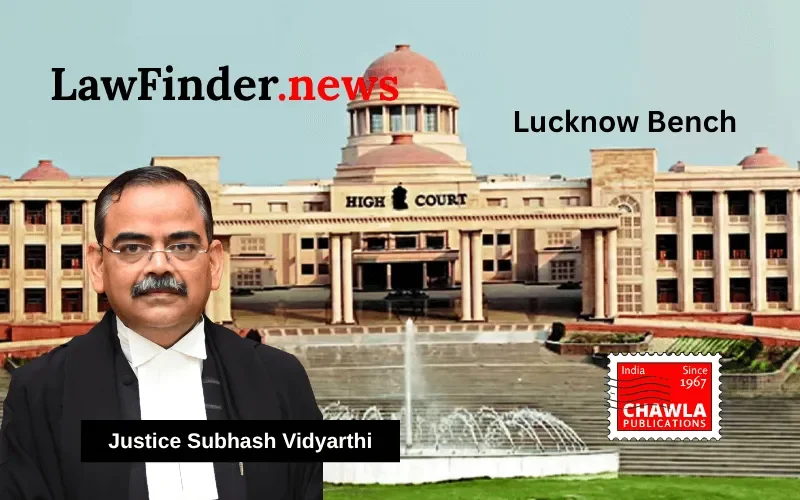
In a significant judgment delivered on October 27, 2026, the Allahabad High Court (Lucknow Bench), presided over by Justice Subhash Vidyarthi, modified the conviction of Teerathraj, who was earlier sentenced to 10 years rigorous imprisonment under Section 326A of the Indian Penal Code (IPC) for an acid attack. The Court, after a detailed examination of the medical and testimonial evidence, held that the prosecution failed to prove that the victim sustained "grievous hurt" or injuries with lasting impact as required under Section 326A IPC.
The case arose from a complaint filed on March 17, 2017, wherein the appellant, a relative of the victim, was accused of pouring acid on the victim while he was returning from his shop. The medical report initially recorded fresh acid burn injuries covering approximately 35% of the victim's body, including the neck, head, chest, wrist, back, and thigh. The victim was referred to a general surgeon at the district hospital for expert treatment.
However, crucially, the subsequent medical examination dated March 30, 2017, revealed no visible injuries remaining on the victim's body, and there was no evidence of any further treatment or expert opinion indicating permanent damage, deformity, disfigurement, or disability. The Court found that mere proof of burn injuries without lasting consequences does not fulfill the stringent requirements of Section 326A IPC, which mandates permanent or partial damage or grievous hurt caused by acid.
The Court relied heavily on the principles of statutory interpretation, emphasizing that Section 326A, which prescribes a minimum sentence of 10 years, should be strictly construed. The term "burns" used in the section must be read ejusdem generis (of the same kind) with other expressions like permanent damage, maiming, disfigurement, and grievous hurt. A simple burn that heals quickly and leaves no lasting marks or functional impairment cannot be equated with the "burns" envisaged in the provision.
Citing precedents including the Supreme Court's decisions in Maqbool v. State of U.P. (2019), Edakkandi Dineshan v. State of Kerala (2025), and Vijay Madanlal Chaudhary v. Union of India (2023), the Court underscored the importance of interpreting the provision in light of the context and legislative intent. The Court also applied the principle of noscitur a sociis, interpreting the word "burns" in association with other injuries listed in Section 326A IPC.
Though the Court quashed the conviction under Section 326A IPC, it found the appellant liable for a lesser offence under Section 324 IPC, which deals with voluntarily causing hurt by dangerous weapons or means, including corrosive substances. Given the evidence of acid being poured on the victim and causing injuries, the appellant was sentenced to the maximum term of three years imprisonment and fined Rs. 10,000, with an alternative simple imprisonment of three months in default of payment.
The appellant had already undergone imprisonment exceeding the revised sentence term and was accordingly ordered to be set free on furnishing a personal bond and sureties under Section 437-A Cr.P.C. The Court appreciated the assistance provided by the advocate who aided in deciding the matter.
This judgment clarifies the scope of Section 326A IPC in acid attack cases, emphasizing that the severity and permanence of injuries are critical for attracting the stringent punishment prescribed. It serves as a precedent for courts to differentiate between grievous acid injuries and lesser injuries caused by corrosive substances, ensuring fair and precise application of criminal law.
Bottom Line:
Penal Code, 1860 - Section 326A - Acid attack - Mere proof of burn injuries is not by itself sufficient to attract Section 326A IPC where injuries healed within 13 days and left no visible marks or functional impairment - Word "burns" in Section 326-A has to be read ejusdem generis with other expressions like permanent damage, deformity, maiming, disfigurement, disability or grievous hurt - In such case, conviction can be altered to Section 324 IPC for voluntarily causing hurt by corrosive substance.
Statutory provision(s):
Indian Penal Code, 1860 - Sections 326A, 324, 320, 313, 374, 437-A
Teerathraj v. State of U.P., (Allahabad)(Lucknow) : Law Finder Doc Id # 3008385