Court highlights overlapping jurisdiction between Family Courts and Gram Nyayalayas in maintenance matters, calls for streamlining to ensure access to justice at district level
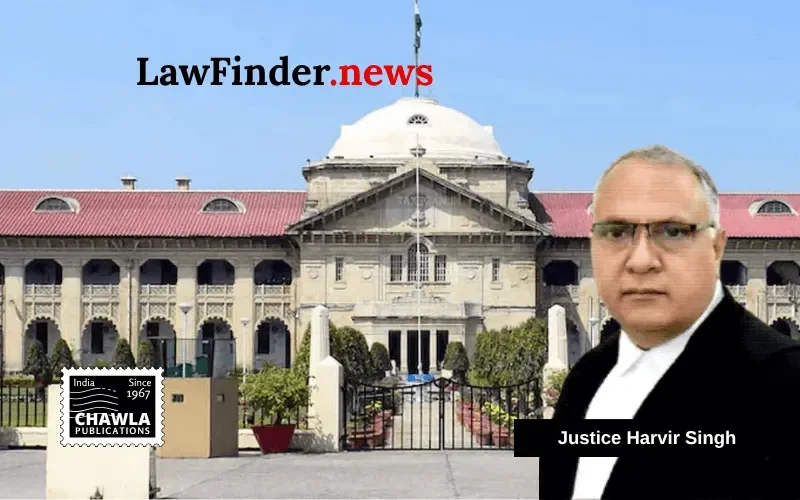
In a landmark judgment dated November 6, 2026, the Allahabad High Court, presided over by Justice Harvir Singh, delivered a comprehensive ruling in the case of Rajendra Singh v. State of U.P. This judgment addresses critical issues concerning the jurisdictional framework of maintenance cases under the Bharatiya Nagarik Suraksha Sanhita, 2023 (BNSS) and the Code of Criminal Procedure (CrPC).
The applicant, Rajendra Singh, challenged orders passed by the Family Court, Agra, including a maintenance order dated November 20, 2003, and subsequent execution proceedings culminating in a warrant dated July 23, 2025. The applicant contended that the initial maintenance order was passed ex-parte without proper notice and sought to set aside the order after a delay of over two decades, which the Family Court rejected.
The Court firmly held that an application under Section 528 BNSS (analogous to Section 482 CrPC) is not maintainable to challenge orders passed under Sections 125 CrPC or corresponding Sections 144-147 BNSS relating to maintenance. Instead, the proper remedy lies in invoking the revisional jurisdiction under Section 397 CrPC or seeking relief under the Family Court Act. The Court dismissed the applicant's Section 528 BNSS petition, emphasizing the availability of an efficacious alternative remedy.
A significant aspect of the judgment is the detailed analysis of jurisdictional overlaps between Family Courts (established under the Family Courts Act, 1984) and Gram Nyayalayas (established under the Gram Nyayalaya Act, 2008). Both forums currently exercise concurrent jurisdiction over matrimonial disputes and maintenance cases under Chapter IX of the CrPC (now Chapter X BNSS). The Court noted that this duplication creates judicial inefficiency, disparity, and confusion, particularly since Family Courts are presided over by officers of the Higher Judicial Services (HJS), whereas Gram Nyayalayas are headed by Judicial Magistrates of the First Class.
The Court highlighted that prior to the Family Courts Act, maintenance cases were adjudicated by First Class Magistrates, who remain fully competent to handle such matters. The current arrangement, where Family Courts exclusively exercise jurisdiction over such cases, has led to an undue burden on higher judiciary and limited litigants' access to justice at the district level.
Further, the Court observed that under the Protection of Women from Domestic Violence Act, 2005, First Class Magistrates are empowered with wide powers to grant interim relief including maintenance and residence orders. This contrasts with the limited powers exercised by Family Courts under BNSS/CrPC maintenance provisions, thereby underscoring the need to restore and streamline Magistrate jurisdiction in matrimonial and maintenance matters.
In view of these findings, the Court recommended that Magistrates of the First Class be posted or attached within the Family Court system to adjudicate maintenance cases under BNSS/CrPC. This, the Court reasoned, would harmonize jurisdiction, prevent overlap, reduce litigation burden on High Courts, and enhance access to speedy justice for vulnerable litigants such as women, children, and aged parents.
The Court also reiterated the Supreme Court's guidelines from Rajnesh v. Neha (AIR 2021 SC 569), stressing the social justice purpose of maintenance laws to prevent destitution and vagrancy among dependent wives and children. It underscored the necessity of awarding maintenance from the date of application to avoid undue hardship due to procedural delays.
Finally, the Court dismissed the revision petition challenging the maintenance order dated 20.11.2003 on the ground that notices were duly served and the delay condonation application was rightly rejected, thus upholding the Family Court's order awarding maintenance.
The Registrar General of the High Court was directed to place this judgment before the Chief Justice for consideration of attaching Magistrates within the Family Court scheme, with compliance to be completed within three months.
This judgment is a significant step towards rationalizing matrimonial and maintenance litigation in Uttar Pradesh, ensuring that the jurisdictional anomalies are addressed, and vulnerable parties receive timely justice at the grassroots level.
Bottom Line:
Application under Section 528 BNSS/482 Cr.P.C. challenging orders under Sections 125 Cr.P.C./144 BNSS is not maintainable. Remedy lies in revisional jurisdiction under Section 397 Cr.P.C. or Family Court Act.
Statutory provision(s):
Sections 125, 126, 127, 128 CrPC; Sections 144, 145, 146, 147 BNSS 2023; Sections 7, 8, 19 Family Courts Act 1984; Sections 11, 12, 14, 18 Gram Nyayalaya Act 2008; Section 12 Protection of Women From Domestic Violence Act 2005; Sections 397, 482 CrPC; Section 528 BNSS 2023
Rajendra Singh v. State of U.P., (Allahabad) : Law Finder Doc Id # 3131876