Court holds that division under U.P. Cooperative Societies Act, 1965 mandates compliance with Section 16 procedure, leading to disqualification of Committee members from pre-divided societies, emphasizing statutory adherence and legal consequences
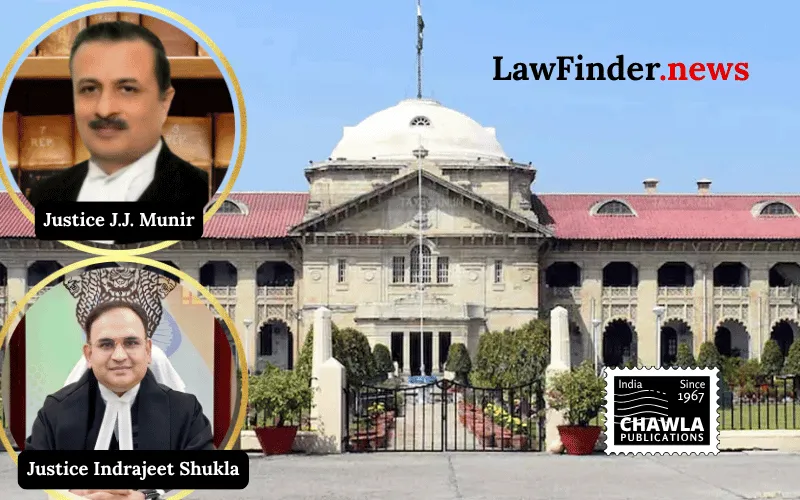
In a significant judgment dated September 7, 2026, the Allahabad High Court (Division Bench comprising Justices J.J. Munir and Indrajeet Shukla) delivered a detailed ruling in the writ petition filed by Sachin Kumar Jain against the State of Uttar Pradesh and others, addressing the legal intricacies arising from the division of cooperative societies under the U.P. Cooperative Societies Act, 1965.
The petitioner challenged the continued functioning of certain members of the Committee of Management of the District Cooperative Bank, Muzaffarnagar, who, according to him, had become disqualified due to the division of their original cooperative societies. The respondents included members elected from societies that had undergone division under Section 126 of the Act, 1965.
The crux of the dispute revolved around whether the division of cooperative societies, executed by the Registrar of Cooperative Societies under Section 126, which involved slashing the area of operation and reconstituting societies, led to the cessation of delegates' membership and consequent disqualification from the Committee of Management. The respondents contended that the original societies retained their names and registration numbers, and thus their identity and legal status remained unaltered.
The Court examined the statutory provisions, particularly Sections 126 and 16 of the U.P. Cooperative Societies Act, 1965, and relevant rules under the U.P. Cooperative Societies Rules, 1968. It highlighted that Section 126 empowers the Registrar to divide societies in public or cooperative movement interest, but the division must be followed by the detailed procedure prescribed under Section 16 to complete the legal process of division. This procedure involves the registration of new societies, cancellation of the old society's registration, and redistribution of assets, liabilities, and area of operation.
Critically, the Court observed that the mere retention of the original registration number and name by the pre-existing societies post-division is a ministerial formality that does not negate the fundamental change in their juristic identity. The alteration in area of operation, assets, liabilities, and membership composition results in the creation of new legal entities. Consequently, delegates from the original societies cease to hold their positions under Rule 87(ix) of the Rules, 1968, which mandates that a person ceases to be a delegate if the society he represents is divided into two or more societies.
Further, Rule 453(1)(h) stipulates that a member of the Committee of Management must be a member of the general body of the society. Once the delegates ceased to be members of the original general bodies due to division, they became disqualified from continuing as Committee members.
The Court underscored the principle that statutory authorities must act strictly within the procedure prescribed by law, citing precedents including Nazir Ahmad v. King Emperor (AIR 1936 PC 253), Bhavnagar University v. Palitana Sugar Mill Pvt. Ltd. (2003) 2 SCC 111, and others. Any deviation from the prescribed statutory procedure renders the act invalid or incomplete.
Ultimately, the Court ruled in favor of the petitioner, directing that the disqualified delegates must be restrained from functioning as members of the Committee of Management. The decision reinforces that division of cooperative societies under the Act entails substantive legal consequences beyond mere administrative adjustments, ensuring democratic and legal compliance in cooperative governance.
This judgment provides clarity on the legal framework governing cooperative society division in Uttar Pradesh and sets a precedent emphasizing strict adherence to statutory procedures to maintain the integrity of cooperative institutions.
Bottom Line:
Division of Cooperative Societies under Section 126 of the U.P. Cooperative Societies Act, 1965, necessarily requires compliance with the statutory procedure under Section 16 of the Act. Retention of the original registration number and name of the pre-existing society does not negate the legal consequences of division. Members of the Committee of Management cease to hold office under Rule 87(ix) and Rule 453(1)(h) of the U.P. Cooperative Societies Rules, 1968, upon division of the society.
Statutory provision(s):
U.P. Cooperative Societies Act, 1965 Sections 126, 16, 7, 9; U.P. Cooperative Societies Rules, 1968 Rules 87(ix), 453(1)(h)
Sachin Kumar Jain v. State of U.P., (Allahabad)(DB) : Law Finder Doc Id # 2978350