Court Holds That Commercial Court Cannot Amend Plaint to Confer Jurisdiction When Found Lacking Subject-Matter Jurisdiction; Defendant's Application Under Order VII Rules 10 & 11 CPC Takes Precedence Over Plaintiff's Amendment Application Under Order VI Rule 17 CPC
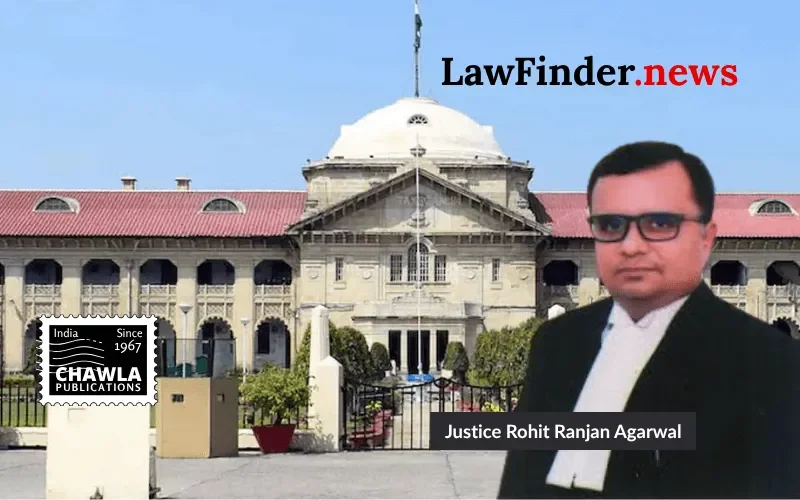
In a significant judgment dated October 8, 2026, the Allahabad High Court, presided over by Mr. Rohit Ranjan Agarwal, J., clarified the procedural hierarchy and jurisdictional requirements in commercial litigation involving suits filed under the Commercial Courts Act, 2015. The Court held that when a challenge to the subject-matter jurisdiction of a Commercial Court is raised through an application under Order VII Rules 10 and 11 of the Civil Procedure Code (CPC), such challenge must be adjudicated before the Court entertains any application for amendment of the plaint under Order VI Rule 17 CPC.
The case arose from a trademark and domain name infringement suit filed by M/s I Think Apps Pvt. Ltd. against Anugya Gupta and another before the Commercial Court, Varanasi. The plaintiff's suit sought permanent and mandatory injunctions against the defendants for unauthorized use of trademarks `Sarkari Result' and domain names `sarkariexam.com' and `sarkariresult.com'. Notably, at the time of filing, the plaint did not disclose the specified value of the subject-matter of the suit, a statutory requirement under the Commercial Courts Act, 2015.
Following the institution of the suit, the defendants filed an application under Order VII Rules 10 and 11 CPC, contesting the maintainability and jurisdiction of the Commercial Court on the ground that the plaint did not disclose the specified value of the subject-matter, which must be not less than Rs. 3 lakhs as per the Act. The defendants further contended that the suit did not disclose a cause of action and the court lacked territorial jurisdiction.
In response, the plaintiff filed an amendment application under Order VI Rule 17 CPC, seeking to amend the plaint to state the specified value of Rs. 5,00,000 to cure the jurisdictional defect. The Commercial Court directed that the defendant's jurisdictional objection application be decided first.
The plaintiff challenged this direction before the Allahabad High Court, arguing that the amendment application to cure the defect should be heard first to avoid the dismissal or return of plaint, which would force the plaintiff to file a fresh suit, causing delay and additional expense.
The High Court, after considering extensive precedents including the Supreme Court's ruling in Harshad Chiman Lal Modi v. DLF Universal Ltd., emphasized the distinction between territorial/pecuniary jurisdiction and subject-matter jurisdiction. The Court reiterated that subject-matter jurisdiction is fundamental and goes to the root of the power of the Court to entertain the suit. A court lacking subject-matter jurisdiction cannot confer jurisdiction upon itself by allowing an amendment to the plaint.
The Court further observed that an amendment seeking to supply essential juridical facts conferring jurisdiction is not a mere procedural cure but effectively changes the nature of the plaint. Therefore, such amendment cannot be permitted while the jurisdictional challenge is pending.
The judgment draws on authoritative rulings by various High Courts and the Supreme Court which hold that any order passed by a court without subject-matter jurisdiction is a nullity and that neither consent nor amendment can cure such jurisdictional defects.
Accordingly, the Allahabad High Court dismissed the writ petition and upheld the Commercial Court's order that the defendant's application challenging jurisdiction under Order VII Rules 10 and 11 CPC must be adjudicated before considering the plaintiff's amendment application under Order VI Rule 17 CPC.
This ruling reinforces the procedural safeguard that jurisdictional challenges, particularly those going to the core of a court's power to hear a suit, must be resolved at the earliest stage to prevent judicial time wastage and avoid rendering subsequent proceedings a nullity.
Bottom Line:
Civil Procedure Code - Where objection to subject-matter jurisdiction of Commercial Court is raised in an application under Order VII Rule 10 and 11 CPC, such application has to be decided first - Court lacking subject-matter jurisdiction cannot entertain or allow amendment of plaint under Order VI Rule 17 CPC to cure foundational jurisdictional defects such as non-disclosure of specified value under Commercial Courts Act, 2015.
Statutory provision(s):
Civil Procedure Code, 1908 - Order VI Rule 17, Order VII Rules 10, 11, 13;
Commercial Courts Act, 2015 - Sections 2(1)(i), 6, 12
M/s I Think Apps Pvt. Ltd. v. Anugya Gupta, (Allahabad) : Law Finder Doc Id # 2994150