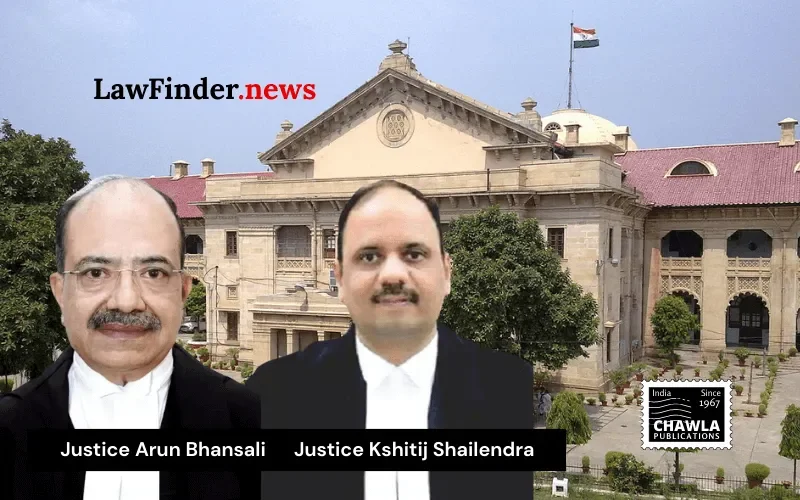
Court criticizes Commercial Court for inadequate judicial scrutiny in lease dispute between Penguin Random House India and Mindmill Software, emphasizing need for detailed reasoning on damages and holding over issues
In a significant judgment delivered on November 4, 2026, the Allahabad High Court (Division Bench comprising Chief Justice Arun Bhansali and Justice Kshitij Shailendra) set aside the order dated December 8, 2023, passed by the Commercial Court, Gautam Budh Nagar, which had upheld an arbitral award in favor of Mindmill Software Limited against Penguin Random House India Private Limited. The appeal under Section 37 of the Arbitration and Conciliation Act, 1996 challenged the Commercial Court's dismissal of objections filed by the appellant under Section 34 of the Act relating to a commercial lease dispute.
Background and Facts:
The dispute arose from a lease agreement dated March 28, 2008, between the parties for commercial premises, initially for three years. Subsequently, a registered lease was executed on June 24, 2009, for 11 months at Rs. 5 lakh per month. After expiry of this registered lease on May 23, 2010, the appellant continued to occupy the premises without handing over possession, leading to claims by the respondent for rent and damages for unauthorized occupation.
The respondent appointed a sole arbitrator, who passed an award on September 5, 2012, directing the appellant to pay damages at Rs. 50,000 per day for over-holding and other costs. The appellant challenged this award before the Commercial Court, which dismissed the objections, leading to the present appeal.
Key Issues:
1. Adequacy of Judicial Scrutiny by the Commercial Court: The High Court found that the Commercial Court's order was largely a reproduction of the arbitral award and submissions without meaningful evaluation of evidence or legal reasoning. The court emphasized that judicial adjudication requires a focused and reasoned analysis of material issues raised.
2. Application of Section 116 of the Transfer of Property Act, 1882: The appellant contended that by accepting rent after the lease expiry, the respondent had effectively renewed the lease under the statutory doctrine of "holding over," thereby negating the claim for damages. The court noted that this issue, including the specific terms of the lease agreement (Clause 11), was not properly examined by the Commercial Court.
3. Reasonableness of Damages under Contract Law: The arbitral award imposed damages at Rs. 50,000 per day, relying on Clause 11 of the 2009 lease. The appellant argued that this was excessive and inconsistent with Sections 73 and 74 of the Indian Contract Act, 1872, which require damages to be reasonable and not exceed stipulated penalties. The court pointed out that these provisions and principles of mitigation and reasonable compensation were not considered.
4. Conduct of Parties Regarding Possession: The appellant submitted evidence of attempts to hand over possession, including emails and key exchanges, which were ignored by the Commercial Court. The court found that the conduct of parties concerning possession and delays in removal of fixtures required proper adjudication.
Supreme Court Precedents and Legal Principles Cited:
- The court relied on precedents such as Kailash Nath Associates v. Delhi Development Authority (2015), Somdatt Builders-NCC-NEC (JV) v. National Highways Authority of India (2025), and Bombay Slum Redevelopment Corporation v. Samir Narain Bhojwani (2024), underscoring the limited scope of interference in arbitral awards and the necessity for meaningful judicial scrutiny in Section 34 proceedings.
- The Full Bench judgment in Shiv Nath v. Ram Bharosey Lal (1969) was referred to in interpreting Section 116 of the Transfer of Property Act and the doctrine of holding over.
- The judgment reiterated that courts do not sit in appeal over arbitral awards but may interfere in exceptional cases such as when awards are rendered without consideration of merits or contain patent illegality.
Decision and Directions:
The Allahabad High Court expressed strong disapproval of the Commercial Court's handling of the case, describing the dismissal of objections as a "summary disposal" lacking judicial scrutiny. Consequently, it set aside the order dated December 8, 2023, and remanded the matter to the Commercial Court, Gautam Budh Nagar, directing it to decide the case afresh in accordance with law and after hearing the parties, with utmost expedition.
The Court also directed that the amount deposited by the appellant under earlier orders shall remain invested as before and subject to further orders by the Commercial Court.
Significance:
This judgment reinforces the principle that courts must engage in meaningful judicial scrutiny when adjudicating objections under Section 34 of the Arbitration and Conciliation Act, 1996, rather than merely reproducing arbitral awards. It highlights the importance of examining contractual provisions like "overholding" clauses in light of statutory doctrines such as Section 116 of the Transfer of Property Act and applying principles of reasonable compensation under contract law.
The decision serves as a reminder that judicial intervention in arbitration is limited but not non-existent and that ensuring the reasonableness and legality of arbitral awards is vital to uphold the rule of law and contractual fairness.
Bottom Line:
Arbitration and Conciliation Act, 1996 - Section 34 - Commercial Court failed to undertake meaningful judicial scrutiny of the arbitral award by rendering a non-speaking and inadequately reasoned order. Matter remanded to the Commercial Court for fresh adjudication in accordance with law.
Statutory provision(s): Arbitration and Conciliation Act, 1996 Section 34, Section 37; Contract Act, 1872 Sections 73, 74; Transfer of Property Act, 1882 Section 116