Court directs judicial officers in Uttar Pradesh to ensure statutory safeguards under Bharatiya Nagarik Suraksha Sanhita, 2023 are strictly followed before taking cognizance, especially in matters involving police personnel.
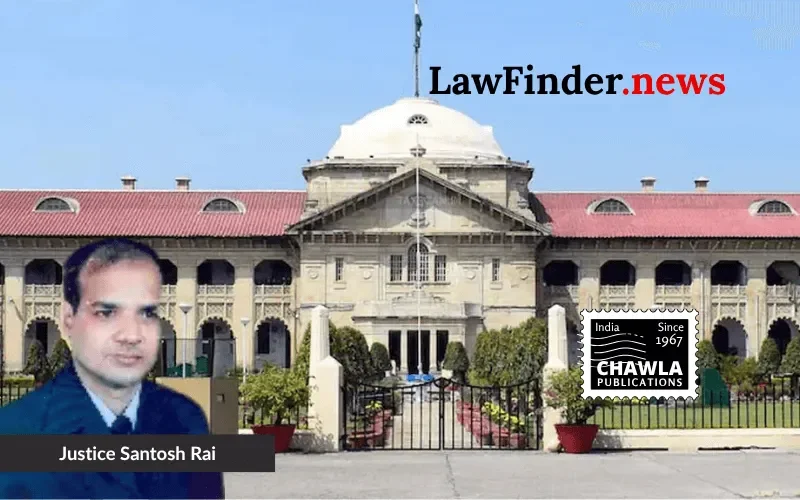
In a significant judgment delivered on November 17, 2026, the Allahabad High Court, presided over by Justice Santosh Rai, quashed the order of the Special Judge (SC/ST Act), Kanpur Nagar, which had converted an application under Section 173(4) of the Bharatiya Nagarik Suraksha Sanhita (BNSS), 2023 into a complaint case. The case, Manoj Kumar Paswan v. State of U.P., involved serious allegations against police personnel for caste-based abuse, assault, and misconduct during the discharge of their official duties.
The appellant, Manoj Kumar Paswan, had filed an application under Section 173(4) BNSS alleging that police officers posted at Police Outpost Parm Purwa had registered a false case against him and had subjected him and his relatives to physical assault and caste-indicative abuses. He also complained that despite lodging multiple complaints, no effective action was taken by the police authorities, and the police personnel were colluding with the opposing party.
The learned Special Judge had ordered the application to be registered as a complaint case and fixed the matter for recording the statement of the complainant under Section 223 BNSS. However, the High Court found that the Special Judge had failed to adhere to mandatory procedural safeguards under BNSS, particularly Sections 175(3), 175(4), and 223(1) & (2), which require judicial satisfaction of a prima facie case and compliance with special safeguards when complaints involve public servants.
The Court noted the following critical points:
1. Non-Compliance with Statutory Safeguards: The Special Judge did not examine whether the conditions laid down in Section 175(3) and 175(4) BNSS, such as receiving reports from superior officers and considering the public servant’s assertions, were fulfilled before initiating complaint proceedings against police personnel.
2. Mandatory Opportunity of Hearing: As per Section 223(1) BNSS, cognizance of an offence cannot be taken without giving the accused, especially public servants, an opportunity to be heard. The Court observed that the Special Judge failed to afford such opportunity, rendering the proceedings unsustainable.
3. Judicial Scrutiny Required Before Taking Cognizance: The Court emphasized that applications under Section 173(4) BNSS should not be mechanically converted into complaint cases. Judicial officers must apply their mind to the merits of the application, supported by affidavits and material evidence, and ascertain the necessity of police investigation.
4. Absence of Reliable Medical Evidence: The Court highlighted that the appellant failed to produce dependable medical reports substantiating his allegations of assault, weakening the prima facie case against the police personnel.
5. Role of Police in Maintaining Public Order: The Court recognized the police’s preventive actions under Sections 170, 126, and 135 BNSS in relation to an existing dispute and clarified that mere intervention by police does not amount to misconduct.
6. Guidelines for Judicial Officers: The Court issued comprehensive directions to all judicial officers in Uttar Pradesh, mandating strict compliance with statutory provisions under BNSS when dealing with applications under Section 173(4), complaints against public servants, and complaint proceedings under Chapter XVI BNSS. These include ensuring judicial satisfaction of prima facie cases, recording specific reasons for converting applications into complaints, and safeguarding accused persons’ rights to be heard with access to documents.
The Court referred extensively to authoritative Supreme Court judgments, including Babu Venkatesh v. State of Karnataka (2022), Om Prakash Ambadkar v. State of Maharashtra (2026), Bhajan Lal v. State of Haryana (1992), Popular Muthiah v. State (2006), and Ishwar Chand Sharma v. State of U.P. (2026), reinforcing the principle that courts must exercise caution to prevent misuse of criminal law and avoid mechanical or arbitrary initiation of criminal proceedings.
Ultimately, the Allahabad High Court held that the impugned order was illegal and a failure of justice due to the non-application of judicial mind and procedural impropriety. The appeal was allowed, and the order dated July 9, 2025, was set aside. The judgment mandates dissemination of the directions among judicial officers through the High Court Registry and Judicial Training Institute to promote judicial discipline and protect the rights of all parties.
This judgment underscores the delicate balance courts must maintain between ensuring accountability of public servants and preventing frivolous or vexatious criminal proceedings, thereby safeguarding the integrity of the criminal justice process under the BNSS framework.
Bottom Line:
Application under Section 173(4) of the Bharatiya Nagarik Suraksha Sanhita (BNSS), 2023 cannot be mechanically treated as a complaint case without judicial satisfaction regarding the existence of a prima facie case or compliance with mandatory statutory safeguards, especially when allegations involve public servants.
Statutory provision(s):
Sections 173(4), 175(3), 175(4), 223(1), 223(2), 170, 126, 135, 210 BNSS (Bharatiya Nagarik Suraksha Sanhita, 2023)
Manoj Kumar Paswan v. State of U.P., (Allahabad) : Law Finder Doc Id # 3129782