Court holds U.P. Gangsters and Anti Social Activities (Prevention) Act, 1986 does not create a distinct offence; directs State Government to respond on Supreme Court observations; proceedings under the Act stayed pending further consideration.
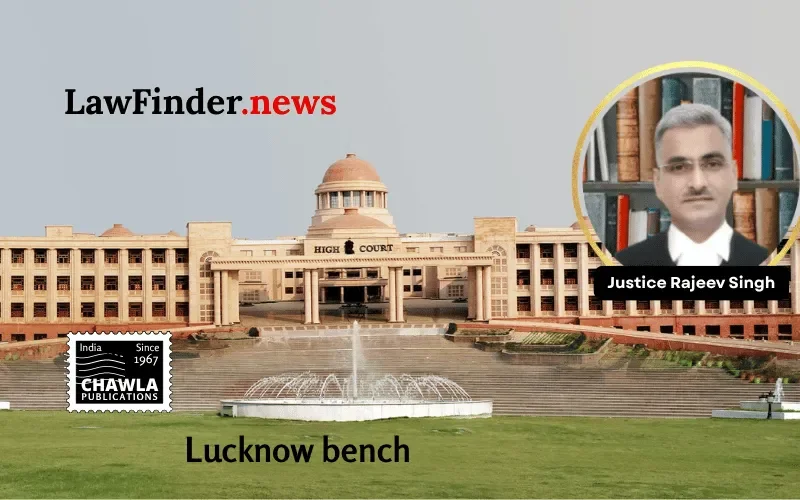
In a significant development impacting criminal prosecutions under the U.P. Gangsters and Anti Social Activities (Prevention) Act, 1986, the Allahabad High Court, Lucknow Bench, has granted an interim stay on ongoing proceedings under the Act. The decision came on October 22, 2026, in the matter of Bhimsen Singh Alias Raju v. State of U.P. and another, following a detailed hearing by Justice Rajeev Singh.
The petitioners challenged the charge sheet and cognizance taken under the Gangsters Act, primarily relying on a landmark Supreme Court judgment in Shiv Pratap Singh @ Chinu v. State of U.P. (2026 SCC Online SC 1677). The Supreme Court held that the U.P. Gangsters Act does not create a separate criminal offence but merely defines the status of a person as a `gangster' based on involvement in crimes punishable under other penal laws. Consequently, punishment under the Act cannot be imposed without an offence being created by law, invoking the constitutional principle of nulla poena sine lege ("no punishment without law") enshrined in Article 20 of the Constitution of India.
The Allahabad High Court noted that the Act's Section 2 defines `gang' and `gangster', while Section 3 prescribes the penalty. However, the Act itself does not create an offence; rather, it prescribes punishment based on involvement in crimes enumerated under other laws such as the Indian Penal Code, Narcotic Drugs and Psychotropic Substances Act, among others. The preparation of a `gang chart' by police authorities determines the status of a person as a gangster, which forms the basis for prosecution and punishment under the Act.
The Court expressed serious concerns regarding the vires of the Act, highlighting the absence of a distinct offence and the risk of punishing a person merely on the "status" determined administratively through the gang chart, without substantive proof of an offence under the Act itself. The Court observed that this could lead to arbitrary detention and prosecution, akin to preventive detention but without the statutory safeguards available under preventive detention laws. It underscored that the Act's provisions allow for prolonged pre-trial incarceration and mandatory punishment upon designation as a gangster, which raises constitutional questions.
Referring to past Allahabad High Court Full Bench decisions and other authorities, the Court emphasized the constitutional prohibition against retrospective criminal liability and double jeopardy under Article 20 of the Constitution. It noted that the Act's provisions could result in punishment without an offence, violating the fundamental principle that "there can be no punishment without an offence in law."
The Court directed the Secretary, Department of Home, Government of U.P., to file a counter affidavit addressing the Supreme Court's observations in Shiv Pratap Singh @ Chinu within three weeks. The applicants were granted two weeks to file a rejoinder. The learned Additional Government Advocate was also instructed to inform the status of the pending Supreme Court case of Irfan Solanki v. State of U.P., which concerns the constitutional validity of the Gangsters Act.
Pending these developments, the Court stayed all proceedings initiated under the U.P. Gangsters Act in the present cases and ordered the release of petitioners if in custody, unless required in other cases.
This ruling marks a crucial judicial check on the application of the U.P. Gangsters Act, underscoring the necessity for criminal laws to clearly define offences and ensure safeguards against arbitrary prosecution. It reaffirms the constitutional protection against retrospective punishment and the requirement that penal statutes create offences with appropriate mens rea and actus reus.
Bottom Line:
U.P. Gangsters and Anti Social Activities (Prevention) Act, 1986 - Proceedings challenged in view of Supreme Court judgment in Shiv Pratap Singh @ Chinu v. State of U.P. - High Court held that matter requires consideration as Supreme Court observed that the 1986 Act does not create a distinct offence and gang chart only determines status of a person as gangster without creation of offence - Interim stay granted to impugned proceedings and State directed to file counter affidavit.
Statutory provision(s): U.P. Gangsters and Anti Social Activities (Prevention) Act, 1986 Sections 2(b), 2(c), 3, 4, 5, 6, 7, 8, 9, 10, 11, 19, 23; Constitution of India Article 20; General Clauses Act (definition of offence); Bharatiya Nagarik Suraksha Sanhita, 2023 Section 528 (referenced in applications).
Bhimsen Singh Alias Raju v. State of U.P., (Allahabad)(Lucknow) : Law Finder Doc Id # 3008780