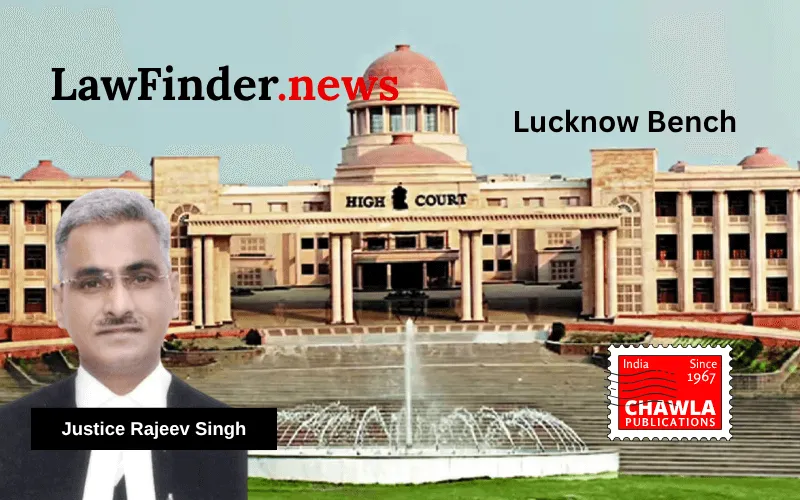
Court confirms validity of Government Order dated 26.02.1999 on 20% horizontal reservation for women; emphasizes merit-based selection and proper application of reservation principles
In a significant judgment dated 16.09.2026, the Allahabad High Court (Lucknow Bench) dismissed a writ petition challenging the selection process for Technical Assistant Group-C posts conducted by the Uttar Pradesh Subordinate Services Selection Commission (UPSSSC). The petitioners, Yogendra Singh Solanki and another, had contested the government's application of horizontal reservation for women candidates, arguing that the selection violated Articles 14 and 16 of the Constitution by improperly lowering cut-off marks for OBC female candidates and misapplying reservation rules.
The advertisement in question, issued on 04.03.2024, provided for 20% horizontal reservation for women across all vertical categories (SC/ST/OBC/Unreserved) in compliance with the Government Order dated 26.02.1999. The petitioners, having scored just below the prescribed cut-off in the OBC category, contended that the Commission's method of applying horizontal reservation resulted in the displacement of more meritorious candidates, thereby violating constitutional guarantees of equality and meritocracy.
However, the Court, presided over by Justice Rajeev Singh, relied heavily on established Supreme Court precedents, including the landmark judgment in Saurabh Yadav v. State of U.P. (2021) 4 SCC 542, to uphold the Commission's methodology. It reaffirmed that horizontal reservation for women operates as an overlay across vertical reservations and does not create separate categories. Women candidates are placed within their respective social categories, with appropriate adjustments made to merit lists to accommodate this interlocking reservation system.
The Court observed that the Government Order dated 26.02.1999, which the petitioners did not challenge, explicitly mandates that a woman's selection against the horizontal reservation must be adjusted within her vertical category. This mechanism ensures a minimum 20% representation of women while maintaining overall merit and fairness. The judgment also clarified that the horizontal reservation does not cap the number of women selected; women who qualify on merit beyond the horizontal quota are also accommodated.
Additionally, the Court noted procedural lapses in the petitioners' approach, such as their failure to implead the selected candidates as parties, which is essential to challenge a concluded selection process affecting third-party rights. The appointment letters for selected candidates had already been issued, and the Court emphasized that interfering at such a belated stage would be inappropriate.
In rejecting the petition, the Court underscored the principle that reservation schemes must balance affirmative action with merit-based selection and that horizontal reservation policies are designed to enhance representation without compromising merit. The judgment serves as an authoritative guide on implementing horizontal reservation for women in Uttar Pradesh public services, reinforcing the legal framework that supports equitable and meritocratic recruitment.
Bottom Line:
Horizontal reservation for women candidates in public services in Uttar Pradesh - Compliance with Government Order dated 26.02.1999 - Selection process held valid despite challenges after declaration of results and issuance of appointment letters.
Statutory provision(s): Articles 14, 16 of the Constitution of India; Government Order dated 26.02.1999 (U.P. Government); U.P. Public Services (Reservation for Scheduled Castes, Scheduled Tribes and Other Backward Classes) Act, 1994; U.P. Public Services (Reservation for Physically Handicapped, Dependants of Freedom Fighters and Ex-Servicemen) Act, 1993
Yogendra Singh Solanki v. State of U.P., (Allahabad)(Lucknow) : Law Finder Doc Id # 2981511