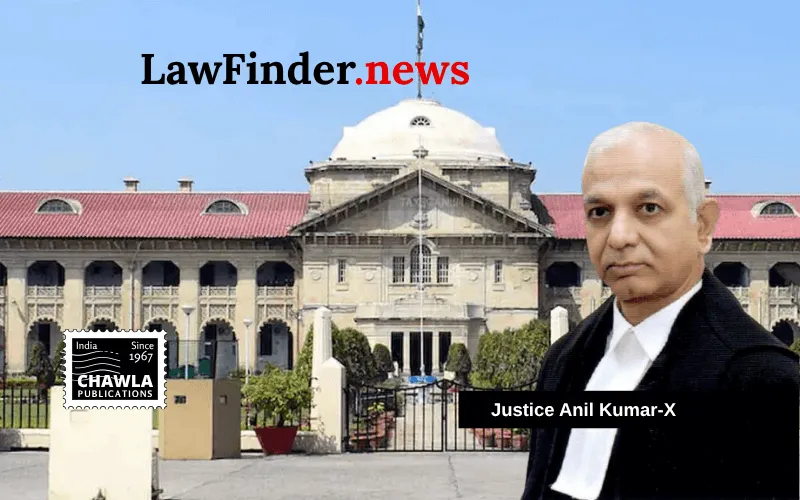
Court Rules That Social Status Cannot Substitute Proof of Income in Motor Accident Claims; No Enhancement Granted Without Reliable Evidence
In a significant judgment delivered on August 21, 2026, the Allahabad High Court (Lucknow Bench) in the case of Smt. Kamla Devi and Others v. Oriental Insurance Co. Ltd. and Another reaffirmed the fundamental principle that compensation in motor accident claims must be grounded on credible evidence, particularly regarding the income of the deceased.
The appeal arose from a tragic accident on May 15, 1999, involving a collision between a rashly driven truck and a Tata Sumo near village Malakiya, District Allahabad. The deceased, Nand Lal Singh Patel, aged about 48 years, was an Advocate and had served as a Cabinet Minister in Uttar Pradesh. The Tribunal had fixed his annual income at Rs. 90,000 based on Income Tax Returns and other evidence, awarding compensation of Rs. 7,84,500 to the claimants after deductions and multipliers.
The appellants challenged the award, contending that the deceased's income was understated and should be considered Rs. 1,60,000 per annum as per his Income Tax Return for 1999-2000. They further sought addition of future prospects, reduction in personal expense deductions, and enhancement of non-pecuniary damages.
Justice Anil Kumar-X meticulously examined these claims and underscored that while the deceased's profession and high social status are relevant, they cannot replace actual proof of income. The Court held that mere filing of an Income Tax Return is insufficient unless corroborated by other reliable evidence. Since the appellants failed to provide independent evidence to verify the higher income, the Tribunal's assessment of Rs. 90,000 was upheld as reasonable and already generous.
Regarding future prospects, the Court relied on the landmark National Insurance Co. Ltd. v. Pranay Sethi (2017) ruling, emphasizing that additions for future prospects apply only after income is firmly established. Since the higher income was not proved, no additional enhancement was warranted.
The claimants' request to reduce the deduction for personal expenses from one-third to one-fifth was also rejected, with the Court noting that the Tribunal applied the method prescribed under the Motor Vehicles Act's Second Schedule, consistent with the practices at the time of the accident in 1999. The Court declined to reopen this aspect based solely on later judicial principles.
On claims for enhancement under conventional heads for non-pecuniary damages, the Court emphasized that compensation must be fair and reasonable, not a mechanical increase of each component. The existing award was found to be just and adequate under the circumstances.
This judgment reiterates that compensation in motor accident claims must be an objective, evidence-based exercise that balances fairness with the avoidance of unjust enrichment. It clarifies that status or assumptions cannot inflate compensation without substantive proof, thus ensuring just recompense for victims' families.
Detailed Analysis and Legal Significance:
The Allahabad High Court in this judgment aligns with the Supreme Court's consistent jurisprudence on motor accident compensation, particularly the principles laid down in Helen C. Rebello v. Maharashtra State Road Transport Corporation (1999), Sarla Verma v. Delhi Transport Corporation (2009), and National Insurance Co. Ltd. v. Pranay Sethi (2017).
1. Proof of Income:
The Court emphasized that the deceased's income must be established by credible evidence. Social or political status, even as a former Cabinet Minister and Advocate, cannot be the basis for presuming a higher income. This prevents arbitrary or inflated compensation awards.
2. Income Tax Return as Evidence:
While Income Tax Returns are relevant, their evidentiary value depends on proper proof and corroboration. The Court observed that the claimants failed to provide supporting documents or testimony to validate the higher income stated in the return.
3. Future Prospects:
The Court clarified that additions for future prospects, as standardized by the Supreme Court in Pranay Sethi, are to be applied only after establishing a reliable income figure. The principle cannot be used to inflate unproven income.
4. Deduction for Personal Expenses:
The Court upheld the Tribunal's application of the personal expenses deduction as per the Second Schedule applicable at the time of the accident, rejecting the attempt to apply newer standards retrospectively.
5. Non-Pecuniary Damages and Conventional Heads:
Compensation for heads such as loss of estate and funeral expenses should be fair and reasonable, not subject to mechanical enhancement. The Court held that the overall award was sufficient.
This judgment provides clarity and guidance for tribunals and courts handling motor accident claims, emphasizing fairness, evidence-based assessments, and avoiding speculative enhancements. It protects insurers from arbitrary claims and ensures dependants receive just compensation aligned with actual losses.
Bottom Line:
Motor Accident Claims - Determination of income for compensation must be based on evidence; mere conjecture or assumptions cannot substitute proof of actual income - Status or social standing of deceased cannot be the sole basis for determining income in claim cases.
Statutory provision(s):
Motor Vehicles Act, 1988 Section 166
Smt. Kamla Devi v. Oriental Insurance Co. Ltd., (Allahabad)(Lucknow) : Law Finder Doc Id # 2980645