Petition to Permit Headscarf in School Dismissed; Court Emphasizes Institutional Discipline and Uniformity
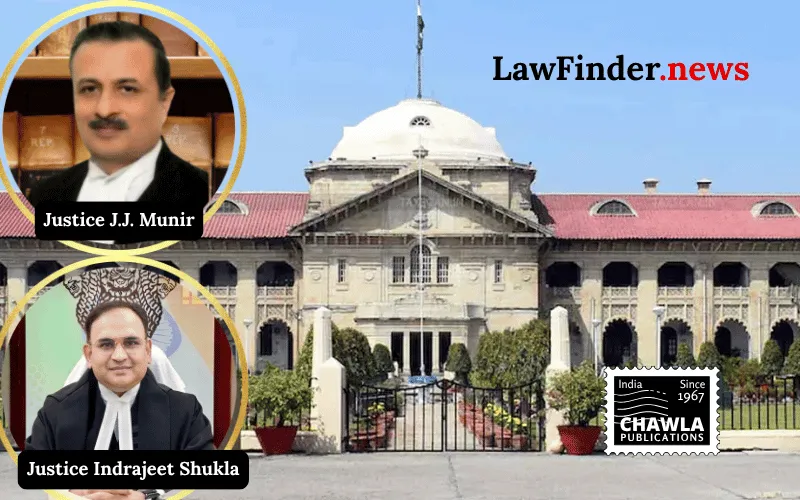
In a pivotal judgment, the Allahabad High Court has dismissed the writ petition filed by Sukaina Rizvi, a minor student of Tagore Public School, Prayagraj, who sought permission to wear a headscarf along with her school uniform. The Division Bench, comprising Justice J.J. Munir and Justice Indrajeet Shukla, underscored the autonomy of educational institutions in enforcing uniform policies that promote discipline, equality, and institutional identity.
The petitioner argued that wearing a headscarf was an essential practice of her Islamic faith and claimed that the school's refusal to allow it infringed upon her fundamental rights under Articles 19(1)(a), 25, 14, and 21 of the Indian Constitution. However, the court held that the school's dress code was bona fide, non-discriminatory, and religion-neutral, and did not violate the fundamental rights as claimed.
The court emphasized that the freedom to manage and administer educational institutions, including the prescription of uniforms, falls within the domain of the institution, especially when it is a private unaided entity. The judgment drew parallels with several precedents where courts have upheld the rights of educational institutions to enforce uniform policies over individual claims of religious attire, highlighting that such policies serve the larger interest of maintaining discipline and equality among students.
Citing the absence of any authoritative religious text or material that established the headscarf as an essential religious practice, the court concluded that individual modifications to the prescribed uniform, based on personal beliefs, cannot be imposed on private institutions without sufficient legal or factual basis. The court further noted that the enforcement of uniformity in dress code is a matter of school discipline, and allowing deviations could undermine the uniform policy.
Despite acknowledging the interim orders in similar cases pending before the Supreme Court, the Allahabad High Court relied on existing precedents to reinforce its decision, pointing out that interim orders are provisional and lack binding precedential value.
This judgment reaffirms the legal stance that educational institutions have the right to enforce uniform policies, and individual religious practices must yield to the broader objectives of discipline and institutional identity within educational settings.
Bottom Line:
Educational institutions have the autonomy to prescribe and enforce uniform policies for students to maintain discipline, equality, and institutional identity. Individual modifications to the prescribed uniform, based on personal or religious beliefs, cannot be imposed on private unaided institutions without sufficient legal or factual basis.
Statutory provision(s): Articles 19(1)(a), 25, 14, and 21 of the Constitution of India
Sukaina Rizvi v. State of U.P., (Allahabad)(DB) : Law Finder Doc id # 2966458